
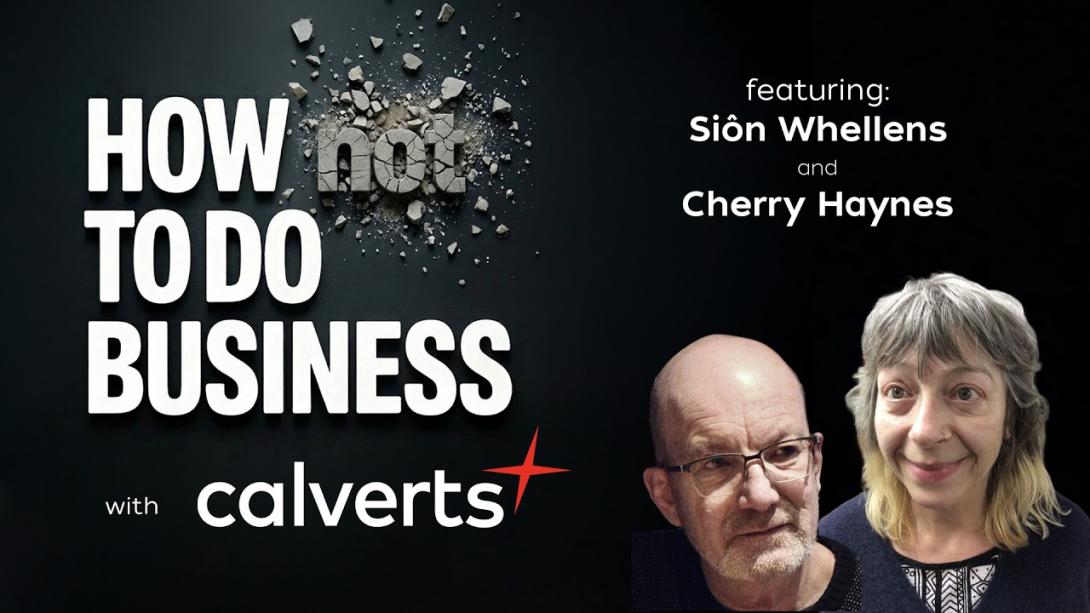
An Interview with Cherry Haynes and Siôn Whellens of Calverts
Clerkenwell and the East End were once full of print shops. Most are long gone. Calverts is still standing — and it's a worker co-operative, founded in 1977, with no managers and complete pay parity: everyone earns the same, no matter the job.
In this episode of How (Not) To Do Business, Chris King sits down with Cherry Haynes and Siôn Whellens of Calverts, the East London design and print co-operative. They explain why Calverts is happy to hire people who are sceptical of co-ops rather than true believers, how it survived the collapse of London's print industry by refusing to compete on price, and why they care more about who controls a business than who owns it — including how that sets co-operatives apart from Employee Ownership Trusts.
You can support Changing the Narrative by becoming a member, and signing up for the newsletter, at https://content.changingthenarrative.media/
Transcript
Siôn Whellens: The prevailing business narrative: workers have to have bosses. There are two kinds of people in this world: there are workers and there are bosses, and workers can't do anything without bosses. That really is the emperor's new clothes. And without even talking about ownership and shareholders, one of the things we challenge most directly is the idea that you have to have tiers of management and people directing other groups of people in the hierarchy to be able to be an efficient organisation. That's actually a very inefficient way to organise any productive enterprise.
Chris King: This is How Not To Do Business from Changing the Narrative. I'm Chris King, and this is a show about companies that are breaking convention, refusing to embrace the usual rules of who owns a business, who makes decisions and who gets paid what, and they're succeeding. Each episode, I talk to the people within these organisations. This week, I'm joined by Cherry Haynes and Siôn Whellens. Cherry is a worker member of Calverts, the East London Design and Print Cooperative. Siôn was a long-standing member and also organises across the wider worker co-op movement.
We get into why they're happy to hire people who are sceptical of co-ops rather than the true believers, how Calverts outlived almost every other printer in London by refusing to compete on price, and why they care more about who controls the company than who owns it. Here's Cherry and Siôn. Enjoy.
Chris King: For somebody who has never heard of Calverts, can you just explain a little bit about what you do first of all, and then, you know, what makes Calverts different to other printing businesses?
Cherry Haynes: Yeah, so we are basically a day-to-day jobbing printer, but with a design studio that we've always had and is a massive part of the business. We put ink on paper, books, posters, magazines, but we also- we've been around for so long, we have the capacity to do basically everything. We know everyone in the trade and can get anything done. We're a profit-making business -- it's not sort of hippy-dippy -- and everyone does everything. We've got incredibly skilled people. We are extremely good at what we do, and I think that comes across with our clients and the suppliers. And there's just a very pleasant day-to-day working environment that I think really comes across to the clients and suppliers. People love to visit us and we just sort of have a good time, 80% of the time. It's not utopia but I think that's one of the main differences, and that really comes across to people who use us.
Chris King: Can you maybe explain a bit about how you function then, as a cooperative? What are the different elements that you've integrated into your process?
Cherry Haynes: Well, it's a straight-up non-hierarchical place, complete pay parity across the board. There's mutual respect amongst us 99.9% of the time. We make no important decisions without meeting, talking, discussing. And of course, we've all got autonomy in our roles to a certain level, but you have the support of everyone around you. There's a lot of interpersonal discussion about the day-to-day running and I think that's a real strength that has kept us going for these number of years.
Chris King: In terms of your backgrounds and your journey into Calverts and just embracing the cooperative spirit, how important do you think that is in terms of having that alternative belief system, that alternative way of perceiving how things should be done? Do you think that's a necessary dimension to people successfully embracing the cooperative business models and integrating effectively into that particular work ethic, or style and approach to business? Or do you think it's something that people who come from a conventional background can easily adapt to and embrace, and would do so with the same kind of positive mindset that somebody who already has that alternative framing.
Siôn Whellens: That's a two-part question. So the first part is, yes, very much so: the overriding ethic is solidarity. So it's working from shared goals and needs, which starts off from the very basic one of decent work. And because it's a very open and transparent -- and also a very democratic, quite a sophisticated democracy, but nevertheless a through and through democratic process -- you find that when you meet challenges together or there are issues internally or externally, you find that there's an enormous reservoir of commitment that people just kind of move to going, "Right, we are going to meet this challenge and we are going to overcome it.".
And you will not find that in even the best privately owned company. You won't find that kind of solidarity ethic, if you like, and it has been tested very severely at times. And it has mobilised us, and we've had to rediscover solidarity from time to time, as a way of thinking about how we relate to each other, and how we relate to the business, and what we do together.
It's not something that necessarily people...we perhaps used to, in the old days, recruit people if they came in talking about co-ops, and how they love co-ops. But what we discovered was that you're much better off just recruiting people who can A) do the job and B) are quite intelligent about- who just ask the right kind of questions, and who are smart, and ask questions about stuff. So we don't any longer require people to know anything about co-ops when they come to Calverts. We put it in the job advert, "Calverts is a workers cooperative," and we just wait to see what questions people ask and how they interrogate that. But most importantly, when they came to work in Calverts how they adapt, how they respond to the culture they're coming into.
Some people get it very, very quickly. Some people it takes longer. So you can find that some people will be like completely on it, and in tune with it in three or six months -- because we do have a kind of induction and education process on the co-op side, so that people have the information and the tools they need to understand this cooperative system. But on the other hand, there are people who who are suspicious of it on a certain level, and maybe take longer to understand that this is actually for real, and that there actually isn't somebody trying to get one over on them, or exploit them or whatever. Because we recruit people from the trade, you know, who've been made redundant three times in the last five years, and they're used to having to fight for every inch of whatever it takes to get and hold down a decent job that pays well, etc. So quite often people come in and they kind of go, "okay, I'll take this at face value," but they're sceptical. But scepticism is good.
Cherry Haynes: Yeah, there's also the fact that not everyone wants to be so fully involved on a certain level. They want a boss and it's difficult for them often to realise that that's them. They are the boss of their own destiny. And that can be quite tricky as well, but can be overcome, definitely. People learn and adapt and change.
Chris King: And I'm sure, as you touched upon earlier, that the cooperative approach is the most advanced means by which a business can be run. If you are recruiting those individuals who are curious, who are questioning things, and sceptical that they're interrogating that and they'll hopefully get to that same conclusion, that it's best for everybody: themselves individually, and the company as a whole, for this particular approach to business.
And you touched upon it there, you're recruiting within the industry, people who've lost jobs. That speaks to how the UK print industry has essentially disappeared. And so what did Calverts do differently that allowed it to survive while others died off.
Siôn Whellens: We've talked quite a bit already about the cooperative culture, and cooperative way of organising. So, talking about this, we've seen the printing industry go from being a major industry in London. Clerkenwell, where Calverts started off, was full of print shops, then the East End was full print shops, now there aren't any, or they're really glorified photocopying shops now. We're a proper printing outfit. And to be honest, I'd say that the single thing is being better than anybody else at what we do, right? Just being the best -- trying to be the best. And we had to struggle, and it took us a long time to be best. And then we -- in the 90s and maybe the 2000s -- it's like we thought "we're actually the best." And then nobody else was around, and we had no competition, or the competition disappeared. I think that's really important, just being really bloody good at it.
But the thing that, "how much of this was strategic and how much was good fortune?" What drives that is that we started out as being probably relatively low-paid, and relatively low-skilled. In order for us to have better lives -- particularly as people started out younger, they got older, they had financial commitments -- how do you improve your life, improve your income, your conditions, and so forth? There's only one way, which is to make the business more successful so that we can all earn more. So that means upskilling ourselves, and upgrading our products and services. And that basically was the driver. So you could say what actually turned us into the best printing company in London was being a bunch of workers who needed to improve their situation, is the way I'd summarise it.
Cherry Haynes: And also a big part of it was holding your nerve, not becoming desperate, being the cheapest in the land. We made a real decision not to 'pile it high, sell it cheap,' just hang on in there and people would recognise, and that seems to have happened. And also we did get people with incredible skill from the outset, which makes a difference as well.
Chris King: Yeah, I suppose it speaks to another way in which Calverts is bucking the trend, or breaking convention; not that race to the bottom, and not just that zero sum game of trying to just compete on price, but actually trying to be the best and deliver, which is great.
And so the culture, how do you feel -- because both of you have been with Calverts for a long time, so you have seen an evolution in terms of the culture -- how do you think it has evolved in the time you've been there?
Cherry Haynes: I think it's improved. It's become sort of less- we did have an issue when I first started, what we called "the Upstairs-Downstairs," because it literally was. The print room was downstairs, and the office and the admin was upstairs, so invariably, it was blue collar versus white collar. Not hideously, but it was there. And maybe the printers may be ringing up the phone lines now, but I think that has changed dramatically over the last decade, and it's just an incredibly friendly, joyous place to be.
Siôn Whellens: I think that Calverts from the beginning did have certain kind of organising principles and one of them was definitely a kind of almost ideological desire to overcome these divisions that happen among workers based on white collar/blue collar, skilled/unskilled, people who've been to university/people who haven't been to the university, let alone gendered and racialized categories between. So that was very important from the beginning. I think in its mature years, what it's actually achieved is, it's gone further than anywhere I know to actually make that real, to actually find the tools to overcome those kinds of divisions.
So although we don't have basic, classic hippie job rotation, we do have a very strong attitude to cross-training between what might be called work of the brain and work of the hands, and looking for ways for people to contribute with all their capacities and not just some bit of what they can do. And we don't take it for granted that because somebody talks a certain way, or didn't go to university or whatever, means that they're not smart. We assume that everybody's smart and what we're looking for is that: is everybody's intelligence. But to do that, you've got to overcome these mindsets that people come in with. I mean, we've probably all brought these kinds of attitudes that we were brought up with, and taught were the natural order of things, when we came to Calverts. And we've had to unlearn that, and learn new ways of thinking about our skills and capacities, and how we relate to each other. And as Cherry says, I think it's we've gone from that being a kind of totem principle to being something that that's more now embedded in the culture of the place.
Cherry Haynes: I'll say certainly, especially in manufacturing, there are certain situations that are inevitable: that is the divide. We have a classic who can work from home, and who it's physically impossible for them to do that? But at least now we just talk about it and nut it out, and try and be bit more flexible for those who physically have to be in the building to get the work done, whereas before it would just be stampy-trotters. But now at least we recognise, and we talk about it and try and adjust it so that everyone's as happy as humanly possible.
Chris King: Then it raises the question that you're making all this effort to create this amazing working environment, empowering and trying to nurture a very positive environment for the individual, and collectively, and for everybody to be happy. And so who leaves, and why do they leave?
Siôn Whellens: Okay, so one of the secret secrets to success is that we do keep people for a very long time, and that means they build up incredible skills and they stay in the place. Having said that, we've got three or four younger workers at the moment who are fairly new in Calverts, but they're doing brilliantly, but our average retention is 16 years, which is quite extraordinary. People leave because they retire. A couple of people have actually retired from work. We have had not so much recently, but in past times we have had times when people thought they could do better somewhere else, particularly in the late 1980s, maybe early 90s, when things were really tough, and there was a kind of feeling you can go and get a career somewhere else.
So people have used Calverts as a launch pad for more or less glittering careers elsewhere. Hasn't happened so much recently, but nothing wrong with that. People get restless. They wanna go and do something else or try something else or change career completely. I mean, we've had people who were like trained graphic designers for years and years and then they wanted to be a gardener, or somebody wanted to go off and be a therapeutic teacher, etc., etc. But in terms of people leaving voluntarily, those are the usual kind of reasons why people leave. They need a lot more money quickly. We can't offer them enough overtime because we don't really like overtime, we like people to just work 35 hours, that kind of thing.
But occasionally people leave because they have to leave, and it's painful and this is the most difficult probably situation in terms of people. The most difficult decision is when somebody is really messing up so badly and consistently, and for so long, that you get to the point that you need to put them through some kind of a process, which in a straight firm would be your line manager writes you up for some kind of disciplinary, etc. And of course we have to stay within the law and Acas guidelines in terms of giving people fair treatment when there's a difficult employment situation. Because we don't have any line managers, so therefore how do you do that?
So when there is a grievance, shall we say, like there's a grievances process or indeed a disciplinary process, what we actually do is we form a group of three members, almost drawn by rota or by lot, who are empowered to deal with it and take it through whatever stages it needs to be taken through. And they have professional advice and support where they need it because none of us are professional HR people. But we have a very clear process, and it's a process that we -- like everything else -- we take our decisions carefully and sometimes slowly, which has always meant we make the right decisions, frankly.
Whenever we've made a bad decision in Calverts about a fellow employee, or about a business situation, or a business challenge, we've taken the decision too quickly and haven't thought about it enough. Now you don't always get time to make decisions; but I think on the business development side, it's taking our decisions very carefully, and listening to what everybody has to say, and encouraging everybody to contribute to every discussion we make about, say, a major investment ,or doing something that's potentially fairly risky in business terms. And then on the people side, It's having a passionate, but nevertheless democratic, process for putting people through a process where it's going to get to the point where they need to make their mind up about whether they're staying or leaving, shall we say.
So it's very, very rare that we've ever actually had to tell somebody to go. Usually there's a better way of dealing with it than a conventional HR process. In most firms the HR process is there essentially to defend the firm and to discipline the worker, and inevitably that's there, on some level, because it is a corporate entity and it is corporate body, so therefore it has its own interest. But we try to align the interests of the corporate body with the interests of the workers as much as possible. That's the best way I can put it.
Chris King: And how did, how did these processes evolve? Did you gain inspiration from other sources, other cooperatives that have been, and just looking at how they had carried out these processes, especially in relation to difficult decisions and/or rapid response to challenging situations? Did you take your inspiration from elsewhere, or is this just kind of an iterative process where you've experimented based on internal discussions and trial and error?
Siôn Whellens: A bit of both. So, fortunately when they started it, they got a lot of things right very early on. But, for instance, our disciplinary and grievance process was okay, but then we looked at how Suma Cooperative was doing it in Yorkshire. I knew the personnel person up there and he told me how they did it, and we basically copied their process. Yep, got that. And another instance was the process by which we turn a new worker into a member of the co-op, because it's not automatic and it's not immediate. And we learned a lot from other cooperatives about their processes and we changed our process to make it less difficult for both parties, because not everybody wants to be a member, for instance, they may be perfectly happy. How do you deal with that if somebody wants to stay in the job, but they don't want to be a member? So we developed some techniques, and definitely there's a lot of co-learning going on from other cooperatives.
Cherry Haynes: I think the main thing we learned over the years is to not rush into it. So now we've got a proper timeline from when you're asked to join the co-op as a director, when you have to accept, but it's a decent amount of time for us all to be sure.
Chris King: Have you experienced a lot of solidarity between co-operatives and that willingness to share experiences around processes compared to the conventional approach where it might be a closed book, and everybody wants to just keep quiet about how they do it in turn?
Siôn Whellens: So we are, we're a member of a worker cooperative federation, which has a hundred or so worker cooperatives in membership. So it's a classic business association, but the big gain from that is that the members do share best practise all the time. So there are forums in that federation where people are looking at all sorts of aspects of business, how you do it cooperatively, and there's an enormous amount of mutual learning goes on in that context, for sure. And, of course, in the business development world where I'm working with new groups who are starting up new co-ops, I'm able to draw on that and show them working examples of how this kind of cooperative does it, how these people do it, or examples of how you formulate policies but in a cooperative way, and all that kind of thing. So yeah, that is tremendously important.
Chris King: And in terms of dealing with informal hierarchies, then, how do you go about doing that? Because obviously you and Cherry have been there for a very long time and others will- you know, if the average retention time is 16 years, then newcomers coming in, there's going to be that disparity in terms of experience and integration into the organisation. So how do you deal with those informal hierarches that can build up?
Cherry Haynes: There's not so much factions as such. What can be there probably is the personal hierarchy, as you know, which I'm guilty of myself, you've been there for so long, you know everything. But luckily, one of the best strategies we've been doing is getting younger people in to take over the mantle. And, luckily, the people we've got are incredibly confident, and after a short while don't mind telling you to wind your neck in, and they know what they're doing -- which is incredibly refreshing, and a relief for those of us who might want to fade out a bit, because we do have to occasionally leave the office.
Siôn Whellens: Then there's the thing about succession. So it's really important that when you've got an experienced member who appears to hold a lot of knowledge, that might even start to look like tacit knowledge rather than open knowledge, is you need a process for them to transfer that knowledge to other people. That's the most important thing. Certainly my experience, there was quite a lot that although the information was all in shared folders, the fact was that people relied on me to sort of know certain things. So I went through that process for maybe a year and a half, of thinking consciously, "okay, how did we shift this?" And it went fine. I mean, I left and they didn't seem to notice. So that was pretty good.
Cherry Haynes: That's the ideal.
Siôn Whellens: The other end, as Sherry was saying, we recruit people who show that they've got enough nous and personal confidence that they are going to be able to stand up for themselves and assert their rights, etc., but who are also open to learning as much as possible, as fast as possible from fellow workers. So that way we're able to shorten this kind of- we do bring people in who are trainees at a basic level, and we've brought people in who are trainees at a higher level -- they've already got some skills. But we try and reduce the kind of- we don't make a lot of it, they're just going through a fairly intense learning process, and they're senior members of the co-op very, very quickly. It doesn't take years, because we don't want that.
Chris King: Do you think there's a difference between the generations in terms of the desire to explore alternative business models like cooperatives, workers' co-ops, or the foundational philosophy and thinking around that in terms of not just isolating it within the business itself, but thinking more expansively and thinking, "right, the whole system needs to change." And that desire for systemic change, do you feel like that's alive and well in younger generations?
Cherry Haynes: I do, certainly, because we have a lot of young kids coming through Calverts -- through the doors, talking to us -- from colleges, or even a lot younger people who are studying the co-op movement, and they come to us and they want to come and spend some time to actually be in a co-op business. But to me, the last five or six years, there's a much greater interest, whereas when I started, it was basically niche, and we were literally told we're Hippies with dogs on strings. And that has completely changed over the years. I would say it's much more respected, the co-op model, now than it ever was, and people know more and are more interested.
Siôn Whellens: And I think in the era that Calverts started, you would say that perhaps the sort of social and ecological and feminist movement, and the anti-racist movement, and anti-imperialist movement used the co-op model to get stuff done for themselves. So Calverts, in a way, came out of that era when people needed to communicate, they needed to do newspapers, propaganda, they need to advertise demonstrations. These businesses came out of that to some extent. The cooperative thing was kind of taken for granted. It was just cooperative; you would do it that way.
I think we're potentially in a cycle now where people are rediscovering that link between democratic business, or democratic and solidarity based enterprise, with the really, really urgent needs of our times, which is the climate crisis, rising and catastrophic inequality, and people are going, "Actually, we're not going to reform our way out of this. There's no shortcut. We are going to have to build a new economy from the bottom up, and we need to do it on different principles."
So I think in some ways it's slightly changed. I would say we came out of this swamp of political and social movements where the co-op way of doing it was taken for granted. And now it's maybe going the other way around that people are saying, "Actually if we need systemic change, we are going have to address the issue of production."
Cherry Haynes: And within that, people are actually putting their money where their mouth is. We have many clients who, of course, know they could get it done much cheaper elsewhere -- China, Europe -- but they actively want to use us. They want us to survive, so they will pay that sort of premium, in a way, which is really heartening.
Chris King: So what do you think then are the barriers to wider adoption of the cooperative model and reaching that critical mass, as it were, whereby people who are walking out with MBAs are actually considering that this is the most advanced model, that this the way forward, that this is how they want to do business.
Siôn Whellens: Well, I think that there are structural barriers, and there are ideological and cultural barriers. So the real obvious structural barrier to cooperative enterprise is access to capital, access to money, particularly workers cooperatives. But in general workers cooperatives are working class organisations, that is to say they're generally formed by people who don't have access to pots of investment capital. And you can do an awful lot, as Calverts showed us, with blood, sweat, and tears, and a bolshie attitude. But actually you do need money at some point because we're still in the capitalist system, and in the capital system you need money; particularly for fixed capital, and for machinery, and things like that.
It's been a massive barrier to cooperatives operating in the platform economy space because it takes an enormous amount of investment to build the infrastructure you need to run a platform or an internet based business, and generally we don't have. You know workers, by definition we're people without capital, that's what a worker is, is somebody without capital. You could say that's one definition. So that's a constant problem.
And also in worker cooperatives, because cooperatives are fundamentally mutual self-help organisations of people who have shared needs and wants -- whether they're cultural, economic, or social -- and the benefit of cooperative enterprises generally is to the members of the cooperative -- that means we're kind of outside the ideology of social enterprise and community benefit, which means we can't tap into pots of charitable money like the National Lottery Fund, or Power to Change, or whatever. So I would say that's the major structural issue.
The ideological and cultural one is trickier, because generally people who do MBAs, what they're studying is generally about how to make capital make more capital. They're capitalists, in framing. It's so widely and deeply accepted that the purpose of capital is to generate profit. And also the other, I would say an even deeper kind of psychological barrier, is this idea that I think we're all quite imbued with, that what makes things tick in this world, what produces everything in this world is capital: it's money, not work. Now, I happen to believe the opposite. I believe that capital is essentially manipulative and parasitic. In my mind, capital produces nothing. All it does is it controls, exploits and mobilises labour. But actually everything that we need, all the socially necessary things we need, are all made by, designed by, distributed by workers. All wealth comes from work, I still believe. And in my heart, when you go around, you can somehow still fall for this idea that it's actually capital that makes the world go around. But it isn't. Think that's a really deep thing. Another way of expressing that is that people lack confidence, and they lack an understanding of their own potential, and capacity to do this in a socially productive and democratic way, without this system.
So my observation is, when cooperatives -- and worker cooperatives in particular -- are on the up, and they're doing well and there are more of them, and they're getting bigger and stronger, it's when the working class as a whole is on the front foot. So it's not a coincidence that the last really big burst of worker co-op development was in the 1970s, when workers were earning better wages left, right, and center, getting better conditions, were organising in unions and so forth, and things seemed to be going our way as workers. And then conversely, when times were really tough for worker cooperatives like the 1990s, was a time when workers more widely were getting beaten back, and union rights and organising rights were being removed through legislation, new technologies were being used to widen inequality, as they are again today, actually. Of course, you know, the latest battle is AI. It's potentially liberatory technology that looks like, depending on who's got hold of it, who controls it, is going to be used to reduce wages, essentially. That carries with it a contradiction for capitalism, but nevertheless, we're in a fight.
So I'd say structural: the very obvious one is that we don't have access to capital; ideological and cultural: the belief in capitalism itself, and the belief that money makes the world go around. And then the ebb and flow of the class struggle, frankly. Sorry to mention it, but...
Chris King: No, well, that's important.
Siôn Whellens: Sorry, not sorry, yeah.
Chris King: Exactly. And so how hopeful are you that under the current circumstances, a very dynamic period in human history, how hopeful are you that an understanding of the need for community, for more socialist approach, and systemic change, how hopeful are you that there is going to be that sufficient understanding to allow that to permeate into all aspects of say UK society, and to extract all the tentacles of the capitalist system that is ultimately undermining democracy? It's undermining social structures, it is undermining all these different elements. How hopeful are you that that can actually be achieved?
Siôn Whellens: For me, I'm not sure that I have hope, but I definitely have a belief that it may be getting denied in every way, but we have a choice, workers have a choice. We're not robots, we aren't slaves; we are human beings. We can understand our situation and we can organise to meet our shared needs. Workers and communities can do that, we can do that. So it's everywhere already. There are so many practical living examples of how inside or outside the money system, inside and outside the enterprise system, people are organising: organised communally, organised socially, organised politically. And it's very important to just remember that things may be looking bad sometimes, but we're never beaten, and we can always change it. It is simply, actually, a matter of choice to do things in a different way.
Now, the how you do that. Well, I don't think it's an ideological battle, particularly. I mean, I would love to see cooperativism being taught in schools and universities, but it's more to do with the learning that people get from doing. So for me, it has to be very much action led. It's not about government policy. It's about actually looking at ourselves, and looking at what we can do, and what we're already doing, and building on that and making it stronger, and being confident about it. And not falling for narratives that really have nothing to do with us. So if that's hope, I guess I'm hopeful.
But of course, in the end, it's necessary. We have to do this if we're going to survive as a species. It's a matter of necessity as much as anything else. And actually, we're seeing right now- what are we seeing in the world right now? We're seeing the capitalist competition -- or the capitalist order, or the narrative of peaceful capitalism and globalism -- fracturing and falling apart at the seams. And it's because of battles and tensions inside capitalism itself. So the falling apart of national agreements and international agreements, outbreak of war, simple disastrous interruptions to supply chains, and you realise how fragile all these supply chains are, let alone the fact that they're based on oil and hydrocarbons. It doesn't take much for things to fall apart.
And at the moment we're going through a falling apart phase, and people are going to be feeling it really, really strongly, particularly in Asia and Africa. They're going to have to find ways of doing things -- and we are going to have find ways doing things -- that are different. So to some extent it's driven by crises that are created by the system itself. But the crises in the system itself are actually caused by workers. The biggest issue for capitalism is they want to marginalise us, and pay us less, and make us less, and make us weaker, but they depend on us to run their system for them. That's always been the contradiction and it plays out in different ways and we're seeing it play out in a particular way now.
So I think understanding that we have choice, and we have power as workers; not as vague members of the community, but as workers in our work -- what we do, how we do it, who we do for. We have those choices, and we the choice of how to organise ourselves to do that work, and to make work better. To liberate work, as we call it. And that plays with the question of necessity: something we have to do, and we're going to have to make choices, and we just have to be in a good position to make the right choices at the right time. And again, I don't know if that's a hopeful or a, or a despairing message, but...
Cherry Haynes: Sounds pretty hopeful.
Chris King: I would like to explore the difference between co-ops and employee ownership trusts, because you say that it's really about taking action, and it's not really about government policy, but they can ultimately create greater barriers to embracing cooperative approaches or lessen them. And I think that's one of the key things around employee ownership trusts, is that they're creating these tax incentives. But could you maybe explain the difference between the two, and what do you think is being lost in promoting these EOTs over genuine, fully cooperative business model.
Siôn Whellens: Well, I think the core of it is that EOTs are very much focused on the question of ownership. EOT promotes a model of ownership in trust, for the benefit of workers. And the focus of the way a business transforms from a privately owned shareholder business to an employee owned share holder business using the EOT, uses this sort of tax mechanism that primarily benefits the exiting owner, because they get 100% -- well, up until recently, 100% -- capital gains tax relief on the sale of their business to the workers. So it's focused very much on ownership, whereas cooperatives and certainly worker cooperatives, we focus on the question of control, because ownership is a slippery category, right? Ownership, what does ownership mean? And who cares about ownership, actually? Ownership only matters in as much as it confers the power to determine and control whatever it is that's owned. So we just cut to the chase and go, who controls this?
The second thing is around the question of democracy. So what we say about worker cooperatives, the CECOPA world declaration on worker cooperative says that worker cooperatives practise democracy at every level of the enterprise: not just at the level of board, but at every levels of management and operations. So you embed democratic culture and process deeply. The employee ownership model just doesn't do that.
Now, having said that, there is a bit of a crossover. I know of one or two worker cooperatives that have used the EOT mechanism. One of them was a bit a fake co-op, the other one was a genuine worker co-op that actually used the EOT mechanism to get the tax break that it gives to workers, because workers can get up to £3,000 of tax-free income in their wages if they're in an EOT. And for some co-ops, that's worth hacking that model to get that.
And I also know of employee ownership trusts that don't have any declared allegiance to the cooperative principles, but that nevertheless are relatively democratic. Perl engineering, for instance -- substantial engineering firm -- puts a huge amount of effort into- it makes sure that the majority of its board members are workers, and it puts a lot of resource into training workers to be able to be effective decision makers at board level. So it's not democratic in quite the way that Calverts is, but for a larger firm that really sincerely, genuinely, believes that the collective intelligence of workers is the secret to their business, they can do that as an EOT.
But, unfortunately in this country, the EOT model -- certainly in the interim, the transfer period -- the ownership rests in a trust. So it's not direct ownership by workers, and the trust owns the business. A trust is a black box, it's a private arrangement. HMRC sees it because they want to see the trust deed, but to everybody else it's a blackbox, and it's got maybe three trustees on it: the existing owner, one worker, and one independent person. I mean, we have discovered that actually you can hack the EOT model for cooperatives because you could make the worker co-op assembly, the general meeting of the worker co-op, trustee of the business. So it can be done.
Just as we were getting somewhere with hacking that, we discovered the government in its wisdom decided to have the capital gains tax relief to existing owners, and they also made that capital gains tax payable up front at the beginning of the buyout process, before the true profitability or health of the business was known. So actually what's just happened is that the government has just knocked a leg out from under the EOT model and made it much less attractive to existing owner's. We're in the process of 'fuck around and find out' to see whether it's still of interest to us.
But, you know, there's also more than a suspicion that business owners were just using the EOT model as a basically a tax dodge. And therefore we were seeing a steady flow of conversions of businesses to EOTs. But I would bet, without being able to do a deep dive on all of them, I bet you'd find half of them don't really have an ounce of democracy in them. It's like the classic one I've come across was where the workers were told one morning that, as of today, you are the owners of this business. They were not aware of the entire buyout process; they weren't aware of the EOT transfer. And the old managers stay in place. Nothing changes. It's the same management structure, the same management culture. I've actually seen one, I've been involved with one on that level of contempt. The actual workers are the last people who get asked whether they actually want to do this.
Chris King: Right, yeah.
Siôn Whellens: It's not driven by the workers. It's driven by the owners. So that's my take on it at the moment, but we're waiting to see what shakes out with the latest changes in the EOT regime. We're still interested, and we're still interested in hacking it if it's useful for co-ops. It's not totally straightforward.
Chris King: Thank you for that. Could you maybe just share what you feel, if somebody who is listening, who is working in a conventional business, what would be the thing that would be most transferable from the Calverts model in your experience, that they could embrace most easily and start making that transition to a more egalitarian and cooperative business model?
Siôn Whellens: I think the first thing is that our federation, which is called workers.coop -- that is the name of the federation and it's also our website address -- has an open forum, and it has got its website, and its resources are actually very open and publicly shared, and that includes case studies, how-tos, manifestos, explainers. And then also it has a forum which is for members, but also for anybody who's interested in the worker cooperative way of doing things. And that's forum.workers.coop and that's an open forum so people can come in ask questions see what people are talking about.
But I think to understand that there are people out there who will be only too happy to talk to you about about what you're thinking. Whatever stage you're at, whatever you're thinking about your situation, there are people out there who will be happy to talk to you and take you through it. This is what we want to do. But I think the key thing is to understand that it rather depends whether you're thinking of starting a new thing or whether you think you're taking over something that already exists -- some enterprise that already exists and converting it. So the starting points can be very different. So it can be a group of people who just have seen a need for something that looks like it needs some kind of enterprise or business. It may be something that nobody's ever offered to the market before. So, you may be trying to find out whether there's actually effective demand for it. It maybe a firm that's in dispute, where workers are in dispute with management, either through a union or or unionised, a hot situation like Calverts had in its founding times. It may be somebody who has a business, a small business, and they want to give it to their workers genuinely, that happens. So there are different starting points.
And for an individual person, whatever their situation, they'll be coming from one of those starting points. They'll be thinking, "I need to quit my horrible day job and do something new." The crucial thing is you need to find other people who are on the same page with you and form a group, because a cooperative is in fact not a business. A cooperative is a group of people who want to do something together and they're using a business as a way to do it. It's a group. And so it's about that initial thing of how do you find collaborators and how do we move from being a group of collaborators to a group that's got a serious intention to do something.
And we understand that and it takes time. Sometimes it doesn't, sometimes it can happen very quickly; often it takes time. So I think the thing is, is reach out and find those resources, start talking to people who have some knowledge and understanding of it, who can advise you and find other people who agree with you. Maybe your fellow workers, or it may be going out there and just saying, "I think there's a need for this in our neighbourhoods. And I think it could fly. Who likes the idea? Who wants to meet me and talk about it, and start from there.
Chris King: Well, so to wrap up, what prevailing narrative about business does Calverts existence most directly challenge?
Siôn Whellens: I think it comes back to something we've touched on, which is that the prevailing business narrative: workers have to have bosses. There are two kinds of people in this world: there are workers and there are bosses, and workers can't do anything without bosses. I mean that's number one, it's got to be, because that really is the emperor's new clothes. And without even talking about ownership and shareholders, the role of management I think is one of the things we challenge most directly. The idea that you have to have tiers of management, and people directing other groups of people in the hierarchy to be able to be an efficient organisation. That's actually a very inefficient way to organise any productive enterprise, because actually the role of managers in most organisations is at least 60% disciplinary. It's just keeping people in their place, and it's actually terribly inefficient. And it's even more inefficient when managers are making business decisions on behalf of- managers make terrible decisions. Managers make value-destroying, business-destroying decisions every day. A smart group of workers, and even a very large smart group of workers can manage a business much more efficiently, and much more effectively, than a hierarchical business. And I think Calverts proves it.
So that's probably it. And then the last one would be capital doesn't make the world go round, but until we change the entire system, we are still going to need capital. We still gonna need money, tragically. So be aware.
Chris King: Okay. And so finally, who else is doing interesting work in this space that you feel I should reach out to and interview?
Siôn Whellens: I think if you're interested in looking at the democratic economy more widely than worker co-ops, you could do worse than talk to Stir to Action, which is an organisation. It's a kind of think-do tank that has an arm called Democratic Business Network. They're about to launch a major effort to reboot the social clubs movement. They've got a programme called 21st Century Social Clubs. So they're interested in this sort of a wider question of how we rediscover communal and collective modes of action that are self-reliant and autonomous, beyond productive enterprises. They're looking at all sorts of different types of democratic community-based organising traditions and thinking about how we can reboot and turbocharge them if you like. So that's quite an interesting group to talk to.
The Worker Co-op Federation itself; there are some very interesting worker co-ops in the tech space who are working in 'tech for good', people a lot of the time have come out of Big Tech corporations as developers, as coders, as tech builders; who've come out of it and formed cooperative tech enterprises, and they're working very hard, because obviously tech is the fourth industrial revolution, and in any industrial revolution there's always a choice about who controls this new tech, and what's this new technology for? And there people working in that space in very interesting ways, on open source and non-proprietary software, developing technology solutions that don't sell our data to the highest bidder, and who are thinking about large language models and AI and uses of, and they have their own forum, which is called coops.tech, so it's forum.coops.tech. And again, I could introduce you or you could introduce yourself in the forum there and see who pops up. I can probably come up with some interesting names for you to talk to.
Chris King: Yeah, that's great. Well, thank you so much, both of you, for taking the time to speak to me. I really appreciate it. And yeah, it's inspiring and it generates hope within me that if more people do embrace the cooperative approach, that change can occur and that we can create a better world for more people.
Siôn Whellens: The way I put it is, if we can change things and start doing things, then more people will discover the cooperative approach, is the only way of doing it. I'm nitpicking, but yeah, thanks for that.
Chris King: I hope you enjoyed this episode. Details of what Cherry and Siôn and I discussed are in the show notes. And you'll find this episode and the full archive at content.changingthenarrative.media or click the link in the podcast description where you can also become a member and sign up for the newsletter. Please share, comment, and subscribe wherever you listen to this podcast so more people can learn about the alternative ways we can do business. If you'd like to support the podcast and Changing the Narrative, then please consider becoming a paying member. New episodes of How Not To Do Business are available every second Tuesday. Thanks for listening.
This transcript has been lightly edited for readability.
Add new comment