
This article was originally published in Shelterforce, a national nonprofit publication covering housing. Sign up for their newsletter here.”
Ask a person on the street to describe a food co-op, and the image that often springs to mind is, as one Boston Globe reporter succinctly put it, a “crunchy granola” store “where largely white, affluent customers buy organic grains from bulk bins.”
This image sometimes has been unwittingly reinforced by advocates themselves. A 2011 trade article, titled “Location, Location, Location,” advised readers seeking to develop new food co-ops to site them in communities where residents were “better educated (college or graduate school), with incomes that are slightly above average, with occupation types that are more white-collar and professional in nature.”
Jamila Medley, a co-op consultant and former executive director of the Philadelphia Area Cooperative Alliance (PACA), says the message that was inadvertently communicated was that people of color and working-class people “could not have food co-ops.” Darnell Adams, project manager from 2015 to 2017 for Dorchester Food Co-op in Boston, Massachusetts, adds that conventional analysis at the time reflected a mistaken belief that “market conditions were going to stay the way they were.”
Recently, many Black-led food co-ops have opened across the country, including Gem City Market in Dayton, Ohio, and Detroit People’s Food Co-op in Detroit, Michigan. These co-ops change not only who owns, leads, and shops at food co-ops, but also the mix of items that are stocked on their shelves.
A Fourth Wave of Black Cooperatives
Between 2005 and 2016, only 5 percent of food co-op startups were Black- or people of color-led. That’s according to a recent presentation by JQ Hannah, executive director of Food Co-op Initiative (FCI), a nonprofit that supports new food co-op development. The ones that did exist were referred to as “urban food desert” co-ops.
By 2018, however, 22 percent of food co-op startups fit that category. As of 2026, according to Hannah’s presentation, only half of co-op startups fit the natural food store mold, with the remainder being either Black-led co-ops (most of which are based in cities) or remote rural co-ops.Erin Dale McClennan, president of Fertile Ground Food Cooperative, a co-op startup effort in Raleigh, North Carolina, estimates that, today, more than 60 Black-led grocery co-ops are in some stage of development nationwide.
Jessica Gordon Nembhard, a political economist and long-time co-op historian based at John Jay College in New York City, calls this a “fourth wave” of Black co-op formation; the other three waves occurred in the 1880s, 1930s, and 1960s. Today is “another period where we have lots of activity,” she says,. “Black folks coming together to do not just mutual aid, but [to form] formal cooperatives to engage more in solidarity economics.”
Recovering Black Food Co-op History
The current “crunchy granola” food co-op image dates largely from the 1960s and 1970s. Rooted in the anti-Vietnam War counterculture, these co-ops, by and large, did not seek to compete head-to-head against large grocery chains but, rather, to develop smaller stores that focused on stocking organic food and the products of local vendors.Operating within a market niche that was largely shielded from competition allowed for higher profit margins. Many natural food co-ops continue to thrive, despite chain stores selling organic produce more recently and creating pressures that have led to the closure of some natural food co-ops. Fifteen co-ops celebrated their 50th anniversary this year.
There was, however, an earlier food co-op tradition without a natural food focus. Until the 1970s, most U.S. food co-ops were community-owned, general-purpose grocers or supermarkets. According to Anne Meis Knupper, author of Food Co-ops in America, by 1944, there were 690,000 member-owners of U.S. food co-op stores and buying clubs. That is more than half the nation’s present-day food co-op membership of approximately 1.3 million people. Often called grocery co-ops rather than food co-ops, the movement was diverse and successful. For years, these co-ops often held their own in head-to-head competition with supermarket chains. During the 1930s, a Black-led food co-op in Harlem was so successful that a nearby A&P store (then, a leading grocery chain) was forced to close. At its peak, the Berkeley Food Co-op, founded in 1937, had over 100,000 member-owners, operated 12 supermarkets throughout the San Francisco Bay Area, and generated over $83 million in sales.
Though a few examples of this older type of grocery co-op remain, most of these supermarket-style food co-ops eventually succumbed to chain competition. The Berkeley store itself closed in 1988.
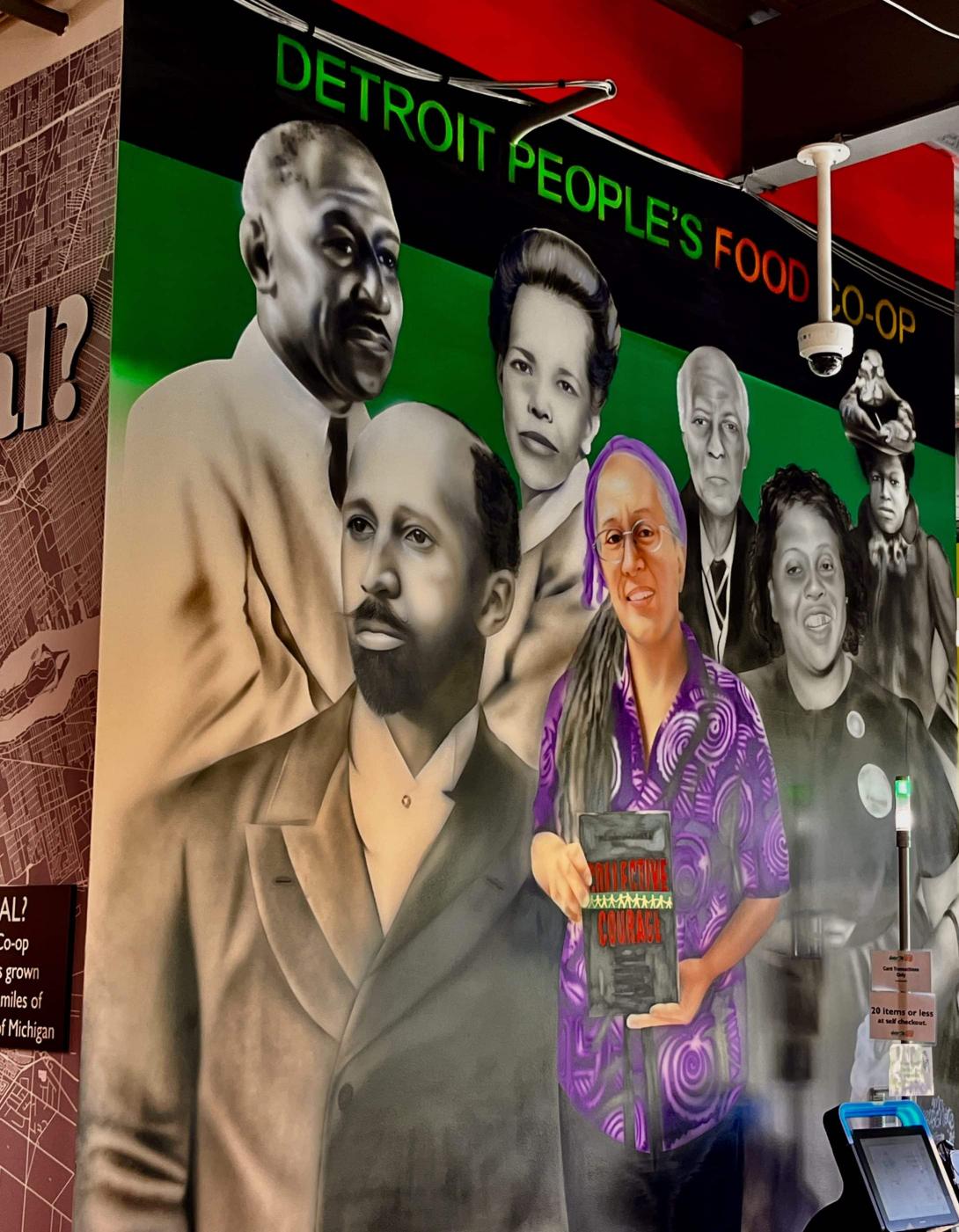
Black-led co-ops, too, have a long history. Gordon Nembhard’s Collective Courage: A History of African American Cooperative Economic Thought and Practice documents a long history of interaction between civil rights movements and cooperative economic organizing. During the 1930s, Black grocery co-ops proliferated. In addition to Harlem, they formed in many other cities, including Chicago; Cleveland, Ohio; Gary, Indiana; New Haven, Connecticut; and Buffalo, New York.
In the South, Gordon Nembhard writes, the co-op form was used to bring independent Black grocers together into a “buying and advertising cooperative” to let them generate the scale needed to acquire goods at discount and more effectively compete against white-owned grocery stores.
In a 2024 interview, Gordon Nembhard emphasized the deep links between political and economic organization. “It is kind of a two-way street,” she says. “We need co-ops to do the political activity, but we also need the economic activity to make the political activity meaningful.” She adds: “The Black co-op movement was really a partner in the long civil rights movement.”
Among the people who supported co-op economic development was a who’s-who of the civil rights leaders, including W.E.B. DuBois; Fannie Lou Hamer; Ella Baker; and A. Philip Randolph and Helena Wilson of the Brotherhood of Sleeping Car Porters.
A New Black Co-op Movement Rises
While the times were very different, the initial impetus for starting Black-led food co-ops in the 2010s was not so different than in the 1930s: economic necessity and the desire for access to healthy, affordable food. Feeding America notes that, in 2023, 27 percent of Black children in the U.S. lived in “food insecure” households. The report also names food deserts as one of the main drivers of food insecurity. A 2020 academic paper notes that another driver of poor health outcomes are “food swamps,” defined as “areas where unhealthy food retailers inundate healthier alternatives.” The authors add that prior research in the field has shown “strong linkages between race and ethnicity, exposure to food swamps and other inequitable food environments, and dietary disparities.”
The current wave of Black co-op organizing is tied both to addressing these health challenges and to racial justice organizing more broadly. For example, the organizing group that ultimately created Gem City Market in West Dayton launched in 2014 in response to the police shooting of John Crawford III at a Walmart store. It adopted the development of a food co-op as a principal goal a year later.
Amaha Sellassie, one of the organizers and the current Gem City Market president, notes that when the group started working on a food co-op, they didn’t think of themselves as part of a tradition of Black-led food co-ops. “We were just organizing because we needed a grocery store,” he says. But Sellassie observes that, because Dayton is hyper-segregated, any locally organized food co-op in West Dayton would be Black led. Gem City Market opened in 2021.
The Black-led food co-op Renaissance Community Cooperative in Greensboro, North Carolina, opened in 2016, a few years before Gem City. Supported by a local foundation, local government, and community groups, its opening seemed like a response to what organizer Ed Whitfield describes as “the prevailing ideas in much of the consulting world … that there was a certain set of demographics that were [necessary] factors for success.”
Renaissance ended up closing its doors in January 2019. In an essay written after the closure, Marnie Thompson, Sohnie Black, and Whitfield—all of whom were deeply involved with the co-op—examined the reasons why the co-op failed.
The challenges, they explain, were multiple. One was the rise of dollar stores. Back in 2013, when the initial market study was conducted, the authors noted that “most dollar stores did not carry significant food merchandise.” But that had changed by the time the food co-op opened in 2016, and that hurt sales and revenue. Other challenges included hiring and training skilled frontline staff in a low-income neighborhood that suffered from education deficits, finding managers who could both manage a grocery business and work with community members, and dealing with an underinvestment in marketing. The co-op also faced a demobilization of the community after the store opened; a focus on movement-building must, according to the authors, be ongoing, since this is where a Black-led food co-op’s competitive advantage often lies.
Although it closed, Whitfield says Renaissance’s example helped to legitimize Black-led food co-ops to the greater food co-op community, which did come around to supporting Renaissance. That community also has since stepped up its support of Black-led co-ops.
Not only did Renaissance inspire organizers in other cities, with Sellassie publicly stating that Gem City organizers are “direct beneficiaries of Renaissance,” but, according to Thompson, Black, and Whitfield, the co-op—even in failing to reach profitability—changed the Greensboro community. The co-op, they write, was not just an economic asset, but a “spiritual” one. “Besides the economic value of wages and benefits, RCC employees received training, got to practice new skills as part of a team, and for many, feel valued and respected for the first time in their working lives,” they add.
Organizing Within the Food Co-op Industry
Renaissance showed that building a different kind of food co-op requires a different kind of development model. There were specific technical lessons: raise more capital to give businesses greater runway; build a larger core membership to give stores a stronger customer base; invest in ongoing movement building. Other lessons, however, had to do with building management and staff skills—and getting the food co-op consulting world to retool its focus so Black-led food co-ops could get support without being steered into the natural foods model.
Part of shifting the food co-op consulting world’s focus involved uncovering how the status quo was, albeit unintentionally, serving to limit ownership and participation by people of color. Jade Barker, a food co-op consultant and one of the participants in the effort to raise consciousness regarding often-unconscious ingrained patterns among co-op consultants, observed that, “In the more than 30 years I’ve been involved with co-ops—student housing co-ops, food co-ops, even a worker-owned collective—almost all of the participants have been white.”
A 2017 report by Barker and Patricia Cumbie—a writer who had long worked with co-ops—titled,provocatively, Everyone Welcome: Personal narratives about race and food co-ops, notes that “most food co-ops that have remained viable businesses are those that have specialized in organic and natural foods.”
“Some [interviewees] see this specialization as a barrier to racial diversity,” the report adds.
Another step was demonstrating community interest by organizing at the local level. In 2016 and 2017, PACA held 20 study circles focused on the history and practice of cooperative businesses. They were inspired by Gordon Nembard’s research, which documented the vital role played by study circles historically in Black co-op business development. Medley, of PACA, credits the circles with greatly expanding Black co-op development in Philadelphia.
Over in West Dayton, Sellassie notes that his group’s extensive organizing experience helped speed co-op development. “We did a whole bunch of pre-organizing work before we officially sold shares,” he says. “And I think because of that, we had 500, 600 members when we came to that first FCI meeting.” That’s a number far higher than co-op norms.
A third important step has been to make space at conferences to organize and build connections among Black-led co-ops. The Up & Coming Conference, formerly led by the Indiana Cooperative Development Center in partnership with FCI, has been a national space for co-op startup organizing groups since 2015. (Starting in 2027, the conference will be co-led by FCI and the National Black Food & Justice Alliance. The 2027 conference will be hosted by Detroit People’s Food Co-op.) The building of a strong network of Black food co-op activists at that event occurred gradually. Adams remembers that the first Up & Coming Conference she attended was “white, white, white” in contrast to the Dorchester community where Adams was working, which is home to large Cape Verdean, Dominican, Haitian, and Vietnamese communities. But over time, Adams notes, “people started linking up.”
One important milestone was organizing a caucus of Black food co-op members, which was initially controversial. Medley recalls that, at one conference in 2016, Black food co-op organizers had requested a session that was explicitly for people of color, but the program descriptions had been changed to remove that stipulation. To ensure the caucus occurred as initially designed required “some serious coordination on the fly,” she recalls, “with support from great white folks who moved in to really help us be able to hold that space still for cooperators of color.”
Those initial sessions progressed to peer calls between conferences, which, in turn, led to the creation of a pre-conference “Black-led day,” supported by the National Black Food & Justice Alliance, a food sovereignty group. It was held annually between 2021 and 2025; in 2026, even as the conference was on pause, Black-led day took place independently in Detroit.
The impact of these actions is palpable. Today, Medley estimates that “a solid third of [Up & Coming Conference attendees] … [are] Black cooperators”—a far cry from the nearly all-white conferences of a decade before. Sellassie observes that “it’s hard to change the culture of a space,” but, eventually, “the whole event has been transformed.”
This organizing has also transformed FCI itself: a majority of its board members are now people of color. The organization now calls a co-op “Black-led” if it is, rather than relying on euphemisms like “urban food desert.” Hannah notes, too, that when they work to support new co-ops, their approach is, now, to co-create a development model with the co-op organizers, rather than try to impose a single model. This flexibility gives Black-led communities forming food co-ops the space to develop strategies to meet the specific challenges they face, such as developing a value proposition—a “why” that attracts customers, even when meeting chain store prices is not possible—that is tied less to natural foods and more to other values like community ownership and community control.
The example of Renaissance has also informed newer developments. Renaissance, in part due to its direct philanthropic backing, opened quickly. Other food co-op organizing efforts—many launched at roughly the same time—were slower to open. Detroit People’s Food Co-op organizing began in 2010, and it opened in 2024. Organizing began for Dorchester Food Co-op of Boston in 2012, and it opened in 2023.
Few would argue that a long organizing period in and of itself is beneficial. In Detroit, Malik Kenyatta Yakini, a longtime Black food justice leader and Detroit People’s Food Co-op cofounder, recalled the strain a couple of years ago, noting that organizers like himself operated “against a backdrop of a certain degree of community skepticism. … After we had been working on this thing for four to five years, there were people saying ‘This is never going to happen. It’s a scam. They are stealing people’s money.’ There were all kinds of rumors.”
Nonetheless, a silver lining of having a longer organizing period has been that these co-ops could learn both from Renaissance’s experience and the new approaches being created.
Successes and Ongoing Challenges
What have the newer co-ops learned? On the positive side, as more Black-led co-ops open their doors, the more recently opened are doing a better job of sustaining themselves. Renaissance only kept its doors open for about 27 months. By contrast, Gem City Market in West Dayton recently turned 5 years old.
Both Gem City Market and Detroit People’s Food started with over 3,000 members. Because many co-ops get a majority of sales from member-owners, this has given them a stronger customer base than Renaissance, which launched with roughly 1,000 member families and had only 630 members as late as November 2015 (six months before launch). Both businesses also are well capitalized.
There have also been technical lessons. Training programs for board, management, and staff are still far from perfect, but they have improved. Store siting is better. For example, the Renaissance co-op had poor visibility from the street. By contrast, the Detroit co-op is located on Woodward, a major Detroit thoroughfare.
However, challenges persist. In Dayton, Sellassie cautions that, while Gem City is “getting good traction and good momentum,” the business is not yet profitable. Part of the challenge: joint purchasing for food co-ops to stock conventional items is less developed than it is for organic produce. While food co-ops are equipped to use scale to purchase organic food at a significant discount, that capacity is largely lacking for conventional food items. This issue is being worked on within the food co-op sector. Co+op Basics, a national joint food purchasing program supported by the National Co+op Grocers (NCG), helps keep some items more affordable. Still, this is not a complete solution.
“Without the larger co-op ecosystem having more conventional products, we’re not going to get a price point where we can actually sell the products anywhere near competitive rate,” says Sellassie.
Part of what keeps the Gem City co-op going, even when its price point is not competitive, says Sellassie, “is the community aspect. … We’re organizing. We got a teaching kitchen. We got a community room in the back.” These services help the food co-op serve the community. The teaching kitchen, for instance, helps customers learn to cook new recipes, which not only builds cooking knowledge but can also help co-op members buy lower cost food while improving food health and nutrition.
The challenges of the Dayton co-op are not unique. Detroit People’s Food Co-op has publicly shared that it has been faltering financially, generating sales that are on pace for roughly $3 million a year, when the co-op’s target is $4 million. At a 2025 webinar highlighting the new wave of Black food co-ops, Gordon Nembhard remained optimistic, even as she acknowledged how difficult new co-op development can sometimes be. Echoing the team that developed Renaissance, she emphasized that even if a co-op fails, such a failure provides “another opportunity … [to] learn more, move on, get beyond it, and get better.”
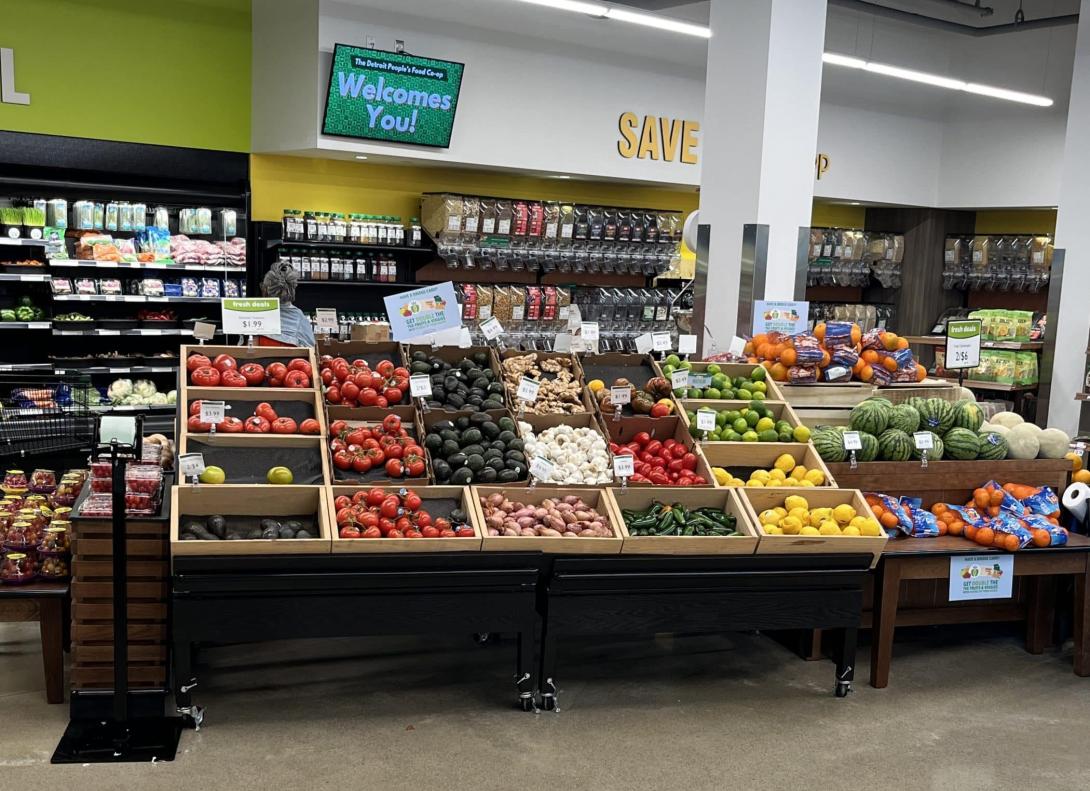
Header image: Detroit People’s Food Co-op, produce section, May 18, 2024. Photo by Steve Dubb.


Add new comment