
How do people navigate commercial banks that can be exclusionary? How do people stop the harm inflicted on them by way of racial capitalism? Can legal advocacy and policy design reframe how we use money in the current financial ecosystem? These questions were addressed at the international symposium: Worlding Feminist Economics: Political Art, ROSCAs, and the Law, which took place in Toronto in April and May 2026. The event was funded by Canada’s major funding agency, the Social Sciences and Humanities Research Council of Canada (SSHRC), alongside a number of global partners. This event was led by U of T’s Professor of Global Development and Political Economy, Dr. Caroline Shenaz Hossein; Windsor Law School’s Dr. Shanthi Senthe; and the Executive Director of the ROSCA Network, Andria Barrett. While bringing together a community of activists, scholars, community leaders, students, and artists, this symposium raised a crucial point: Formal cooperatives must recognize and protect informal membership institutions like ROSCAs as part of the core of the social economy, or risk compromising the entire solidarity economy movement.
Groundings with the ROSCA Movement: What We Learned
Communities across the world have organized member-owned institutions, both formal and informal, to survive against corporatized financial systems. The most predominant cooperative systems across the world are the Rotating Savings and Credit Associations (ROSCAs). Shirley Ardener and Sandra Burman (1964; 1996) define ROSCAs as member-owned and unregulated financial institutions that allow their members to access money through a rotating or shared fund. ROSCAs are known locally as Pardna (Jamaica), Chit (India), Susu or Sousou (Trinidad and Tobago), Equub (Ethiopia), Chama (Kenya), Arisan (Indonesia), and Tandas (Mexico/Latin America) to name a few. Built on the grounds of tradition, community, and radical trust between kin and folks who know one another, these institutions are usually operated by women (not only, as there are mixed and all-male ROSCAs too), who experience significant barriers to commercial banks.
Though formal co-ops (e.g., established credit unions and consumer cooperatives) may overlook these informal institutions due to their lack of legal status; as was determined during the symposium, ROSCAs are still a type of cooperative, and they embody the principles of voluntary membership, democratic member control, and mutual concern for community (see the International Co-operative Alliance website for the list).
To exclude informal co-ops from the broader definitions of the solidarity economy is a simple act of erasure. If the social solidarity movement is to honor its values in truth and inclusion, it must expand its borders to recognize these cultural economies as peers in the cooperative movement, rather than as underdeveloped cooperatives.
Reclaiming Cultural Economics: The Banker Ladies, Art, and Protest
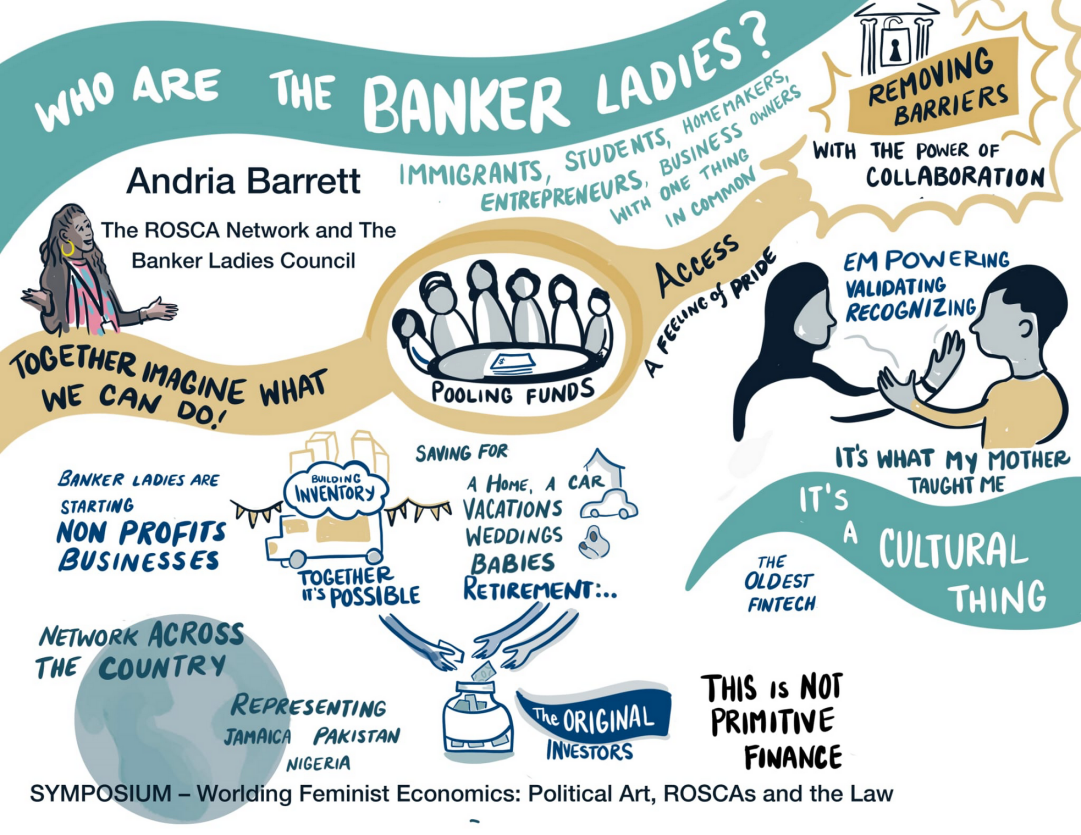
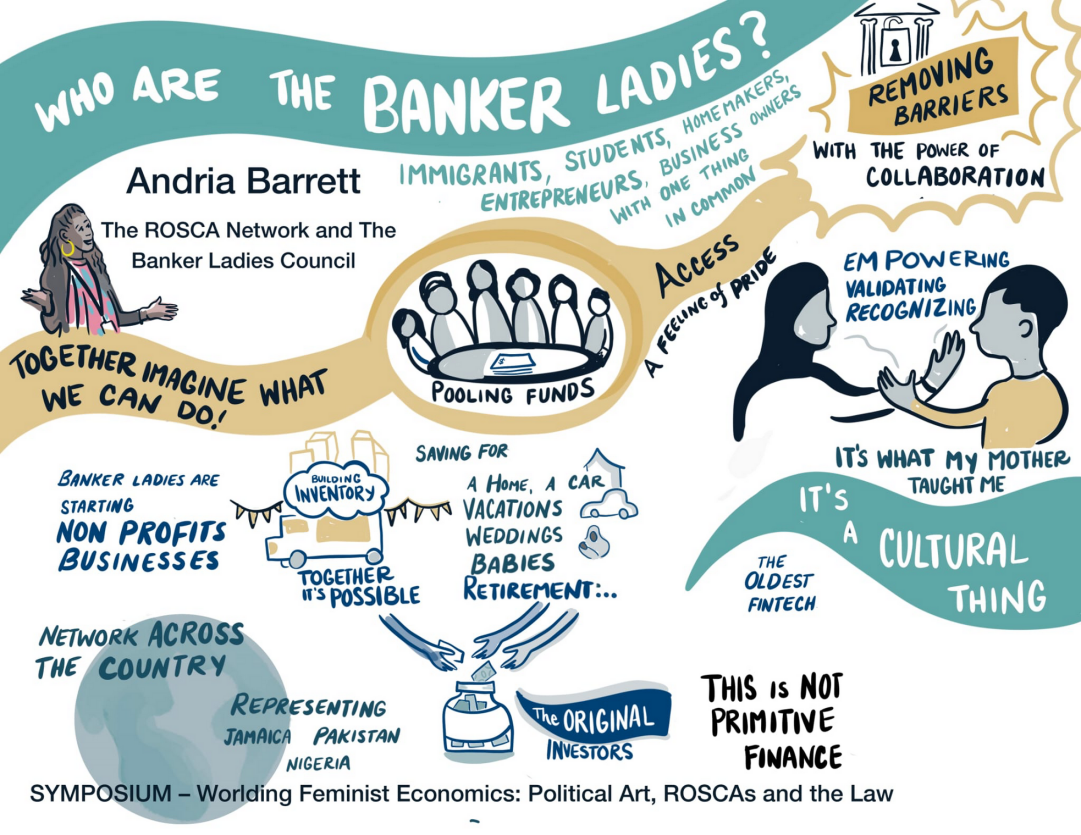
The symposium’s opening lecture by Andria Barrett of the ROSCA Network and The Banker Ladies Council, introduced the concept of the “The Banker Ladies” as a group of Black diaspora women who lead neighborhood financial economies–as women cooperators–across Canada and internationally. In the sketch note below, The Banker Ladies use collectives to fund everything from stocking up on inventory for small businesses and investing in real estate to organizing communal events. An example of self-help ROSCAs from the diaspora, is the use of Pardna forms to help Jamaicans after Hurricane Melissa in October 2025. ROSCAs, as told by Barrett, are more than a financial system. The Banker Ladies serve as an emotional support network to their members during unexpected emergencies, demonstrating how ROSCAs function not only as financial institutions, but as cooperatives vested in reciprocity and mutual care. You can find an academic study of the work of Black women cooperators in the open-access book, The Banker Ladies: Vanguards of Solidarity Economics and Community-Based Banks.
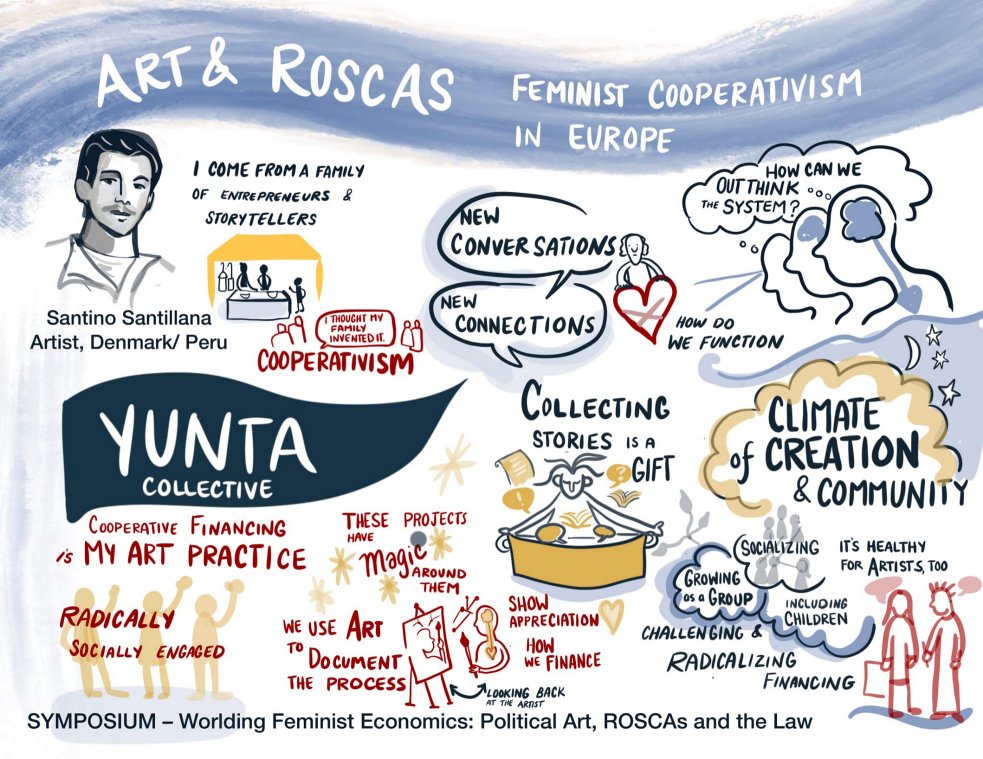
In the keynote lecture, Danish Peruvian artist Santino Santillana presented “Art and ROSCAs: Feminist Cooperativism in Europe” where he showcased visual art and paintings as a tool to disrupt rigid capitalist models. Santillana shared that his artistic path was shaped greatly by his youth involvement in alternative community spaces, as well as his Peruvian aunties–which led him to later rediscover the Yunta, a rotating collective savings system inspired by the traditional practice of Peruvian women in his family who relied on Juntas, the local name for a ROSCA.
To combat the extreme form of precariousness that artists and creatives encounter in Europe, Santillana recalled how Juntas helped his family settle into new countries, and recruited artists and other creatives to form a Yunta Collective. These gatherings centered artistic experimentation, shared meals, family, community trust, and access to financial goods. Santillana highlighted that members utilized ROSCA funds for meaningful purchases that sustained their families and creative practices. Some artists used it towards funding art projects, forming independent community spaces, and some even contributed the money toward family reunifications. True to feminist economics values, this structure is about social provisioning and care work. They are not only operationalizing Yuntas but will hold an exhibit on feminist cooperativism at the Copenhagen Fine Arts Academy. Ultimately, Santillana’s art insists that business institutions must expand their frameworks to honor and protect informal spaces, as they play a vital role in counter-acting against structural exclusion.
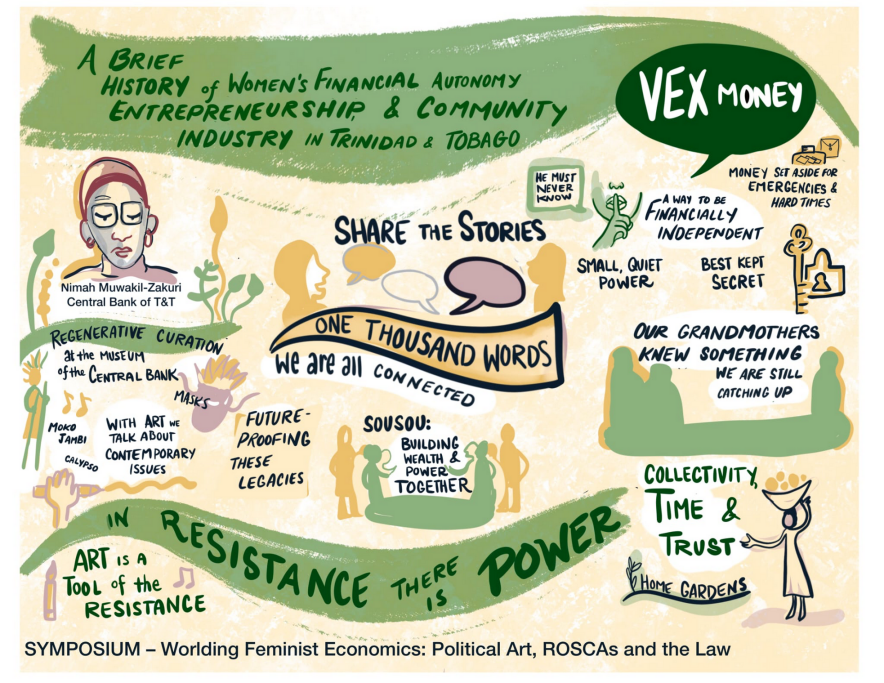
The solidarity economy movement should look towards the Caribbean to see how countries recognize the value of informal member-owned institutions. These co-op networks, both formal and informal ones, have long formed the foundation of economic survival. In a special lecture titled “Vex Money: A Brief History of Women’s Financial Autonomy, Entrepreneurship and Community Industry in Trinidad and Tobago” the curator Nimah Muwakil-Zakuri of the Central Bank Museum of Trinidad & Tobago, highlighted how institutions should center the economic practices that communities have relied on for generations as part of their monetary history. Muwakil-Zakuri spoke on the use of regenerative curation through historical Caribbean artwork that depicted informal financial networks within institutional spaces like the Central Bank Museum. The museum has ensured that the history of shared labor and traditional practice through systems like Susu banks and “vex money” (vex money defined as funds one would set aside in the event of an emergency), are included in the region’s metanarrative on the history of banking. The Central Bank Museum of Trinidad and Tobago’s willingness to expand its economic imagination and to validate the legacy of the Susu, serves as a benchmark for the broader solidarity movement and formal co-operative institutions to match.
Cost of Silence = Risks to the Solidarity Economy
The first panel that day brought to light the intense social stigma faced by informal mutual aid institutions such as ROSCAs. A number of testimonials by participants of ROSCAs as well as some members of The Banker Ladies Council, highlighted the interrogation users face from commercial banks when mobilizing lump sums of cash from the ROSCA. The emotional intervention by The Banker Ladies Council member Mabinty Bangura–a Canadian-Sierra Leonian– made it clear that her Osusu is a gift that she and her friends have contributed to the Canadian way of life. Speakers also challenged the cooperative movement to reexamine what constitutes legitimate economic activity and to include ROSCAs as part of its ecosystem. A turning point in the discussion came from Rob Callender of Kin Co-op (UK), as he shared how he originally pitched an idea for a mutual aid money system to a friend who immediately pointed out, “That’s a Hagbad!” (the ROSCA name used in Somali culture). This moment exposes a lesson for formal cooperatives: marginalized communities do not need institutions to invent new models for them, or to teach them how to be a cooperator. They already know this. The question the solidarity economy movement must ask is: Why do indigenous systems, e.g. ROSCAS, remain marginalized by mainstream cooperatives despite proving to be historically effective in collective organization (Hossein, 2020).
A member of The Banker Ladies Council and a Canadian Nigerian, Esther Enyolu, emphasized that immigrant women who carry the Ajo (a Nigerian name for a ROSCA) tradition are constantly met with surveillance and various forms of criminalization. Urban planner and member of the Banker Ladies Council Agnes Mochama explained that Kenyan women deploy Chamas to build up economic security precisely when formal institutions fail to offer support to them. Professor Ati Ashtari of the University of Washington-Tacoma argued for collaborative knowledge production that rejects studying marginalized groups from an academic distance and highlighted the importance of recognizing the leadership that these women take on. In her study of Balochi women and needleworkers in Iran, she emphasized the agency of women navigating these invisible spaces and insisted that the informal institutions they use, like Sandooq, do not dissolve – rather they grow under the context of war and conflict. These institutions called Sandooq are important to minoritized groups in Iran and elsewhere.
Professor Haddy Njie of North Carolina State University has published on Osusu in The Gambia (2022), and she has found that money pooling is the cornerstone of business in her home country, across West Africa, as well as for African immigrants. If formal cooperatives do not actively recognize these cultural economies that are unapologetically cooperative, then they are leaning towards a colonial legal structure that oppresses and excludes membership and cooperative businesses that have been a lifeline for many peoples across the globe.
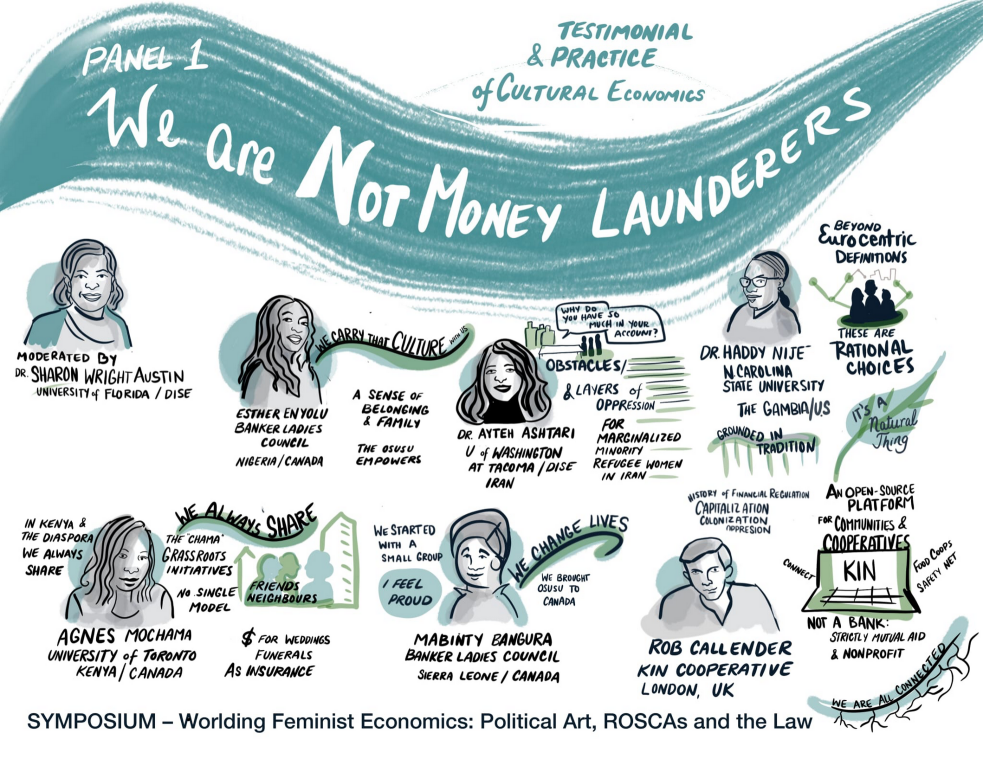
As formal cooperative organizations may overlook informal co-ops; both face distinct risks for being marginal to the corporate system and so lose growth that is available to the cooperative sector. Participants of the symposium argued that the formal cooperative sector –without making ROSCAs a vital feeder into its system– poses an existential risk to itself. In that when there is silence, this non-action by formal actors in the solidarity economy threatens downsizing its membership; and grassroots collective movements may be lost to or coopted by commercial bankers. What participants echoed is that cooperatives who act as ‘friendlier’ versions of commercial banks, lose their credibility, and invite a kind of ‘mission drift’ when they neglect other cooperators. By failing to defend the ROSCA system, mainstream co-ops inadvertently reinforce the capitalist financial model and alienate Susu women who could be growing the sector.
This is why we find that many Banker Ladies and their global counterparts remain deeply vulnerable, facing accusations of money laundering from commercial banks, legal harassment, and persistent exclusion. At times they are even subjected to the confiscation of their funds. When mutual-aid organizations like ROSCAs are left without any form of recognition, their members go underground, ultimately hiding what they do. This is a loss for all of us who hoped to see the solidarity economy and cooperative sector grow.
Can the Formal Cooperative Sector Grow the Solidarity Economy
The Townhall of artists that followed, as well as the panel “Stop the Harm of Informal Institutions”, showed that the point of cooperatives is to change the way we do business in society. In the second panel on harm, speakers explained that, Black, immigrant, and racialized women who carry traditions like Susu, Hagbad, Pardna, or Chamas across generations, eventually accrue what can only be simplified as legal trauma. Professor Sharon Wright Austin of the University of Florida who has published on the Black social economy (2023), confessed that ROSCAs are so underground that she never even knew about them. She confirmed that ROSCAs are indeed plentiful among Americans but noted that they must be hidden because of the stigma and shame that comes with being seen as ‘ponzi schemes’ or ‘illegal activity’. She ultimately refused the notion that ROSCAs are bad and pointed out that they follow in the footsteps of civil rights leader and cooperator Fannie Lou Hamer.
Jamaican Canadian activist and advocate of ROSCAs, Andria Barrett, reasoned that the harms must stop, and the attacks towards ROSCAs are not only financial but are social and institutional. Harms emerge through stigma, deep misunderstanding, and a long-standing fear of informal institutions. She shared an anecdotal story of a Jamaican nurse who contributed approximately $1,000 each month into a Pardna of 12 people, which meant that her hand would be $12,000 in turn. But upon visiting her local bank, she was faced with aggressive behavior, and ultimately the refusal of her funds and an interrogation of their origins. This story illustrates the cost of not acknowledging ROSCAs as legitimate cooperative economic activity when they are in truth a safety net for millions of people.
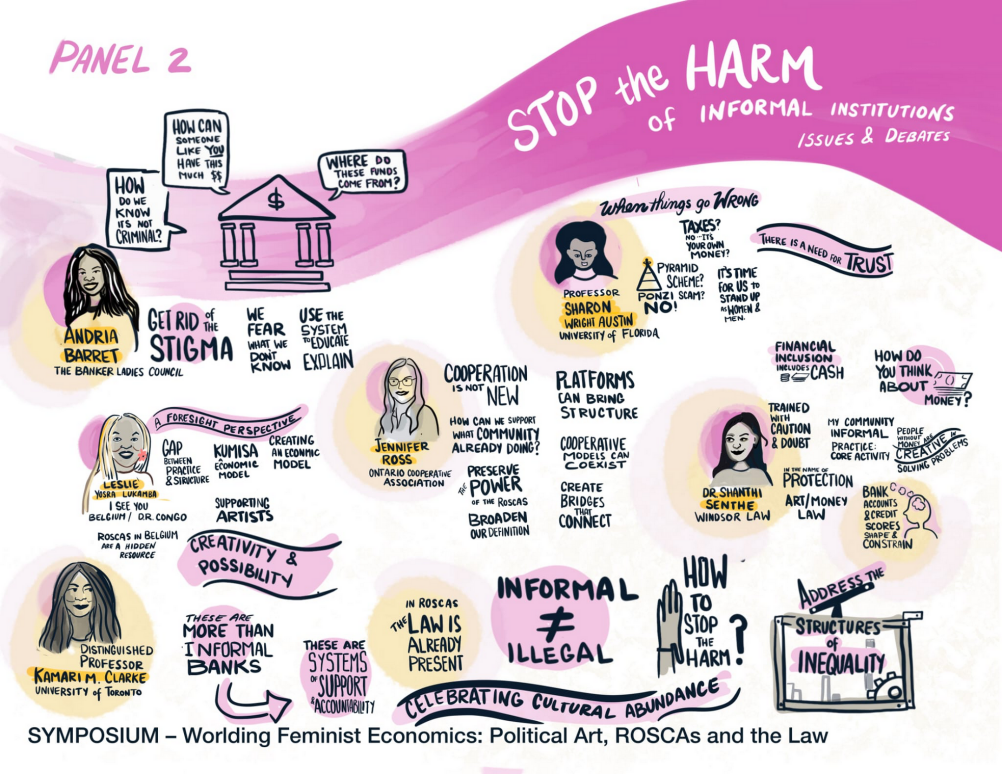
These communities require protective structures to insulate collective finance from a legal order that does not recognize their history. The executive director of Jennifer Ross of the Ontario Cooperative Association argued that it is high time for the cooperative sector to broaden its tent to include other forms of cooperators, and to bridge cooperative institutions altogether. Formal co-ops possess the ability to design protective infrastructure that allows collectives to practice their forms of social financing without facing account closures, surveillance, or having to give up informal autonomy.
For people attending the event, there was a consensus that the legal fearmongering of Banker Ladies is to stop the growth of ROSCAs. A big takeaway from legal scholars Kamari Clarke of U of T and Shanthi Senthe of Windsor Law School, is that ‘the informal’ is a practice already embedded into communities, and that the law exists as a tool to understand these cooperatively organized systems. The structure of inequality detaches the law from communities and individuals. As such, we must recognize that informal institutions are not automatically deviant or illegal under the law.
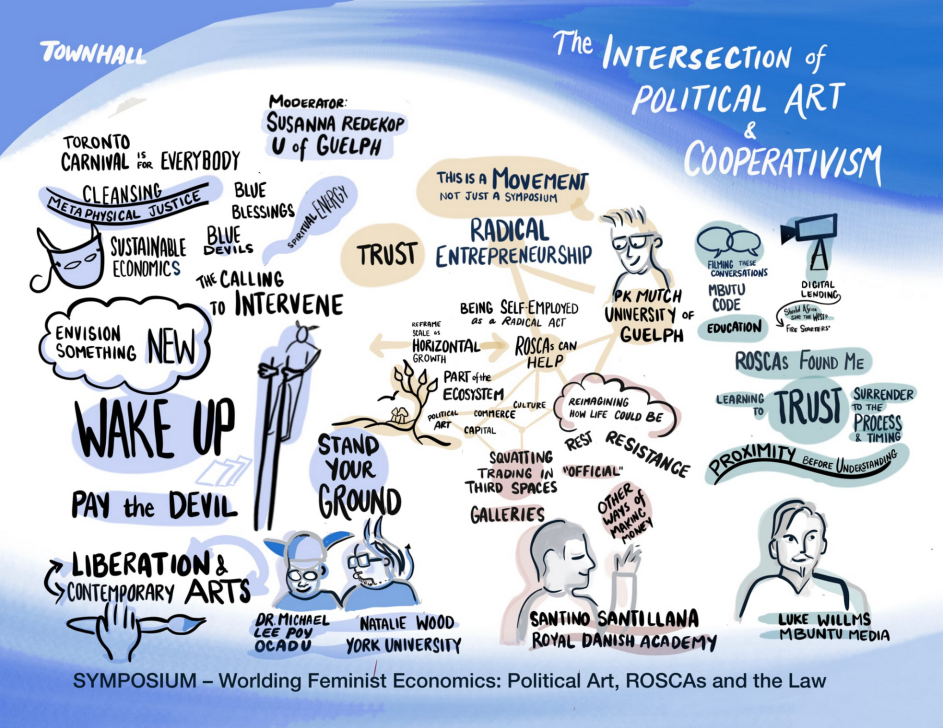
A model of this in action is the UK-based Kin Co-op. Instead of forcing financial traditions into formal systems, Kin Co-op provides a digital infrastructure that allows collectives to practice social financing without giving up their independence. Artists Santino Santillana, PK Mutch, Luke Willms, Natalie Wood, and Michael Lee Poy discussed how the informal economy in its most creative form, thrives in environments outside of the home and workplace where people can gather, collaborate, and build genuine relationships; often referred to as Third Spaces. Whether alternative art exhibitions, feminist businesses, Carnival collectives, or saving circles, these spaces need support and resources that formal co-ops can provide.
Along the lines of structural inequality, is back talk that focuses on cultural and community abundance. The Catalyst for Change Lecture that followed was titled “Why Mutual Aid?” by Jamye Wooten, the founder of Baltimore’s CLLCTIVLY, who admitted from the get-go that he is not trying to help marginalized communities fit into existing institutions, rather, he is interested in redesigning institutions altogether.
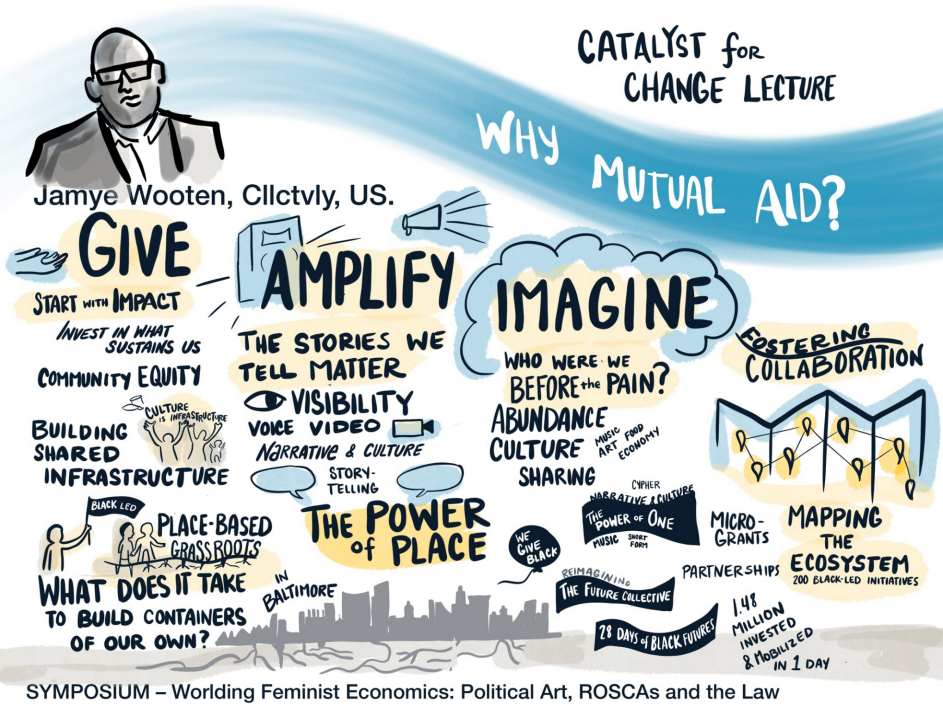
Using the historical example of the Baltimore Arabbers, a street food distributor that served underserved neighborhoods with fresh produce during times of food drought (see Freeman, 1987), Wooten argued that marginalized communities are not “empty spaces” waiting for outside expertise: they already possess an abundance of knowledge and practices that the market narratives intentionally ignore. Wooten shared that while resources often flood into communities during a crisis, movements inevitably lose momentum as they lack durable organizational “containers” capable of sustaining those resources over time. For the solidarity economy, ROSCAs are these containers, and serve as existing systems where cooperation and trust hold communities together. This framework provides a radical conclusion for the cooperative network. Social transformation will not be compatible with top-down institutional reform, or by forcing generational tradition to fit the mold of corporate regulations. The solution already exists, in abundance.
Conclusion: The Black Social Economy is about Abundance
The Black Social Economy finds that there will be groups of people who cannot interact with the state and private sector, as the literature suggests, so there will be institutions like co-ops and ROSCAs which must operate informally to reach those who face exclusion. The final day of the symposium was a reminder of the power of the informal and the abundance of economic activities among racially marginalized groups and minorities.
This symposium is not just another archive of a cooperative gathering, rather, it has inspired a tangible manifesto for a unified solidarity economy that includes informal member-owned institutions such as ROSCAs. It is crucial for the global cooperative movement to be the first in line to embrace cultural economic abundance, and to take a stand with the Banker Ladies of the world. Only then, will we be able to build a people-focused economy that is rooted in feminist economic values of democracy, mutual aid and belonging.
Works Cited
Ardener, S. (1964). The comparative study of rotating credit associations. Journal of the Royal Anthropological Institute of Great Britain and Ireland, 94(2), 201–229. https://doi.org/10.2307/2844382
Ardener, S., & Burman, S. (Eds.). (1996). Money-go-rounds: The importance of rotating savings and credit associations for women. Berg.
Freeman, R. L. (1987). The arabbers of Baltimore. In 1987 Festival of American Folklife Program Book (pp. 20–23). Smithsonian Institution. https://folklife-media.si.edu/docs/festival/program-book-articles/FESTBK1987_20.pdf
Hossein, C. S. (2020). Rotating savings and credit associations: Mutual aid financing. In J. K. Gibson-Graham & G. Dombroski (Eds.), The handbook of diverse economies (pp. 354–361). Edward Elgar Publishing.
Hossein, C. S. (2024). The banker ladies: Vanguards of solidarity economics and community-based banks. University of Toronto Press. https://utppublishing.com/doi/book/10.3138/9781487557034
International Co-operative Alliance. (n.d.). Cooperative identity, values & principles. https://ica.coop/en/cooperatives/cooperative-identity
Njie, H. (2022). Community building and Ubuntu: Using Osusu in the Kangbeng-Kafoo women’s group in The Gambia. In C. S. Hossein & P. J. Christabell (Eds.), Community economies in the Global South: Case studies of rotating savings and credit associations and economic cooperation (pp. 147–164). Oxford University Press. https://doi.org/10.1093/oso/9780198865629.003.0007
Wright Austin, S. D. (2023). The Black social economy and the social and solidarity economy. In I. Yi (Ed.), Encyclopedia of the social and solidarity economy (pp. 92–96). Edward Elgar Publishing. https://doi.org/10.4337/9781803920924
Citations
Caroline Shenaz Hossein, Ilhaam Ladha (2026). Wake Up World: ROSCAS are Part of the Co-op Family!. Grassroots Economic Organizing (GEO). https://www.geo.coop/articles/wake-world-roscas-are-part-co-op-family
Add new comment