

Originally published at Shelterforce
Brent Fosberg is a Lansing, Michigan-based developer. Development is the family business. But Fosberg is not pleased at the sprawling development that has dominated Lansing. “I think there’s a real correlation [between] our level of trust in our institutions and our [urban] design and how we built [our communities],” Fosberg says.
Fosberg believes communities would look different if residents financed development. But, he says, “the way the financing has been set up, it’s hard for people to be able to invest in [their own] community.”
Fosberg hopes to change that with a project called the Lansing Growth Fund. His effort is one of a growing trend of community real estate ownership strategies. At Shelterforce, we have covered many of these. Often, this is done through direct nonprofit ownership or a nonprofit-led trust. In those cases, however, individuals are not doing the investing; nonprofits are. Another form, the permanent real estate cooperative, does offer individual ownership shares, but the financial return is purposefully set well below market—1.5 percent a year for East Bay Permanent Real Estate Cooperative members in Oakland, California, for instance.
People like Fosberg are experimenting with other structures to diversify to the community real estate ownership menu, especially ones that allow residents to invest directly in funds and properties. If these kinds of efforts succeed, community members could gain a new way to shape development, while building household wealth.
What Is a Diversified Community Investment Fund?
Chris Miller is CEO of the National Coalition for Community Capital (NC3). The group’s stated goal is to see “a community investment fund imbedded in every community; locally invested, locally controlled, local wealth-building.” Miller elaborates that the goal is “to return … [to] when we all had local banks and savings and loans and our money all went in there and it then recirculated in the community.”
A challenge in meeting this goal is that federal law strictly limits many types of direct investment, including support for local investment, to people who are “accredited.” Except for trained professionals, to be an accredited investor, an individual or couple must either have a net worth (beyond the value of their house) of at least $1 million or annual earnings of at least $200,000 ($300,000 for couples). This restriction is designed to protect people of more modest means from risky investments, but the rule has the unfortunate outcome, as economist Michael Shuman has long argued, of encouraging over-investment on Wall Street and underinvestment in local Main Streets.
There are exceptions. Co-ops are one of these. A more recently created exception is regulation crowdfunding, which was developed after the federal JOBS (Jumpstart Our Business Startups) Act passed in 2012. Regulation crowdfunding presently allows any individual to invest up to $2,500 in qualified businesses (with greater allowances for those with higher earnings or net worth). Between 2016 and 2025 over 4,300 businesses nationwide raised over $1.5 billion through this mechanism.
One reason why crowdfunding is sometimes considered risky is because investments are typically made in individual businesses and therefore not diversified. A diversified community investment fund (DCIF), as attorney Brian Beckon, who has helped develop and popularize the concept, explains, is designed to solve for this. It can invest in a range of local businesses, provided that 60 percent of fund assets are in real estate “while raising equity capital broadly from the community and sharing profits with those community investors.”
To comply with federal investment law, at least 60 percent of fund assets must be invested in real estate, which is considered lower risk, since it’s typically backed by collateral. The remainder can be invested directly in local businesses. The Kachuwa Impact Fund, a national impact fund based in Colorado, has employed this fund structure since 2005 and manages an investment portfolio of over $30 million, a clear illustration of the potential of this approach.
While Kachuwa has a track record, applying the DCIF model to a local community is quite new. Local Return, a Rhode Island nonprofit, claims to have been the first to launch such a fund. Its fund, started in September 2024, is managed by an affiliated for-profit organization, the Rhode Island Community Investment Cooperative. In Lansing, Fosberg is pursuing a similar model with the Lansing Growth Fund.
More broadly, Miller says that NC3 is exploring this idea with “20-some communities” across the country, including elsewhere in Michigan and with groups in many other states, including California, Colorado, Florida, Georgia, Indiana, New York, Ohio, Oregon, Pennsylvania, Texas, and Washington.
Developing the Model
Jessica David, formerly executive vice president at the Rhode Island Foundation, is president and CEO of Local Return. Josh Daly is the fund’s treasurer and chief financial officer. Daly was a director of two different federal Small Business Development Center branches in Rhode Island from 2014 until 2022. David says Local Return was founded to support “growing from within” rather than the state norm of “trying to recruit and give a lot of incentives to these big out-of-state companies.”
To date, David says her group has raised $345,000 from 44 community investors. The capital raise goal is $3.5 million. She adds that the fund won’t make investments until at least $1 million is raised, a level that she and Daly hope to reach by year’s end.
The fund is structured as an investment co-op, meaning all investors, whether they invest $500 or $50,000, get a single vote to elect board members. The fund structure also favors smaller investors by giving those who invest between $500 and $2,500 their maximum dividend rate (with a targeted rate of 2 to 4 percent annually for seven years) and accredited investors 70 percent of that rate. That said, institutional investors will need to step up for the fund to raise its target, Daly acknowledges.
We really believe that housing development has done better when it’s done by people from within the neighborhood, who know that neighborhood”
Jessica David, president and CEO of Local Return
Echoing Fosberg, David notes that a big part of the philosophy of the investment fund approach is local control of the development: “We really believe that housing development has done better when it’s done by people from within the neighborhood, who know that neighborhood,” she says.
In Lansing, with the Lansing Growth Fund, Fosberg is following a similar playbook as in Rhode Island, with some key differences. Fosberg says he’s aiming for a 5 percent return over 10 years. Fosberg has also used his industry connections to raise short-term construction financing for the first development in advance of launching the fund. In August 2025 the city of Lansing committed $9 million to convert a brownfield site into a 28-unit apartment building, community center, credit union, and cafe. The housing, Fosberg details, will include seven income-restricted apartments with rents set to be affordable to households making 80 to 120 percent of area median income, for 27.5 years; the rest will have market-rate rents, which currently are not much higher than the income-restricted rents, although that might change over time.
The first building is under construction right now, targeted for completion in March 2027. The fund is designed to provide long-term financing, taking out the shorter-term loans and transferring ownership to the residents who invest in it. Fosberg says they have 36 months to raise the equity to do that.
Fosberg envisions the Lansing Growth Fund acting as an “evergreen” fund that grows over time, rather than aiming for a specific target amount. In terms of development objective, he has an initial target goal of about 100 units of housing, as well as modest commercial development, supported by “100 to 200” small investors by the end of the first phase (which Fosberg hopes to complete by March 2027). Ultimately he hopes to have thousands of small investors.
Those small investors are important not just for their dollars—they have a meaningful ownership role. For example, a supermajority of the investors would need to approve a sale of real estate in the fund. It gives the community an ownership voice in the project, explains Fosberg. “And that’s the key to how we structured this—to make sure that agency stays local with the people in the community.”
Community Ownership of Commercial Property
In both Lansing and Rhode Island, the focus has been to create pooled investment funds that can actively shape local economic development. In Portland, Oregon, however, a different model has emerged that vests a large share of building ownership in hundreds of residents who typically do not invest at all. They make deposits of as little as $10 a month into a vehicle that is called a “community investment trust.” Although patterned much like a real estate investment trust, it operates as a standard Oregon shareholder corporation, not a trust.
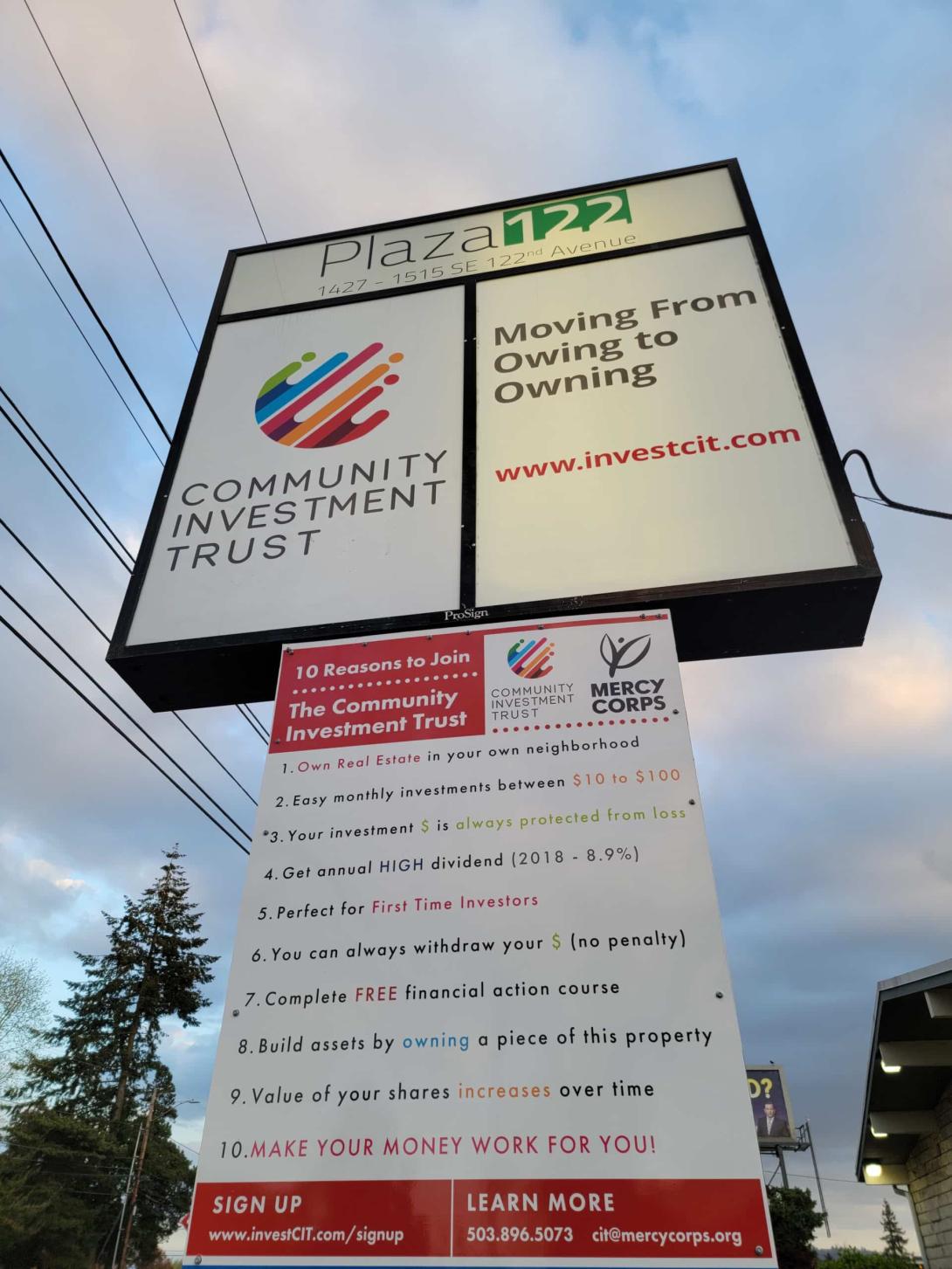
John Haines, who has led the effort in Portland, explains that the core concept involves a localized stock offering, led by a nonprofit or a community organization, “with commercial real estate by localized ownership” defined by local zip codes.
Opened to local community investors in 2017, Community Investment Trust (CIT)—originally East Portland Community Investment Trust—in southeast Portland is the owner of Plaza 122, a 29,000-square-foot retail mall that is home to about 30 business and nonprofit tenants. The scale is modest—after all, 29,000 square feet is smaller than your standard supermarket. But the approach has proven highly effective at helping people with limited incomes save, invest, and build wealth. And the model is spurring imitators from Dallas, Texas, to Albany, New York. (A localized stock offering to allow community ownership of a retail facility was first pioneered for Market Creek Plaza in San Diego in the 2000s, but that model wasn’t widely replicated.)
How the CIT Works
Haines’s initial goal behind the community investment trust was to create a “pathway to get renters a stake in equity in real estate.” To begin, Haines and his colleagues surveyed neighborhood residents, which is how they determined key variables such as the amount of the investment ask, set at $10 to $100 a month. After the community survey, the next step was to find a suitable property to acquire.
Although CIT is now an independent entity fiscally sponsored by the San Francisco Bay Area-based Possibility Labs, it began as a project incubated by Mercy Corps Northwest, part of the international nonprofit Mercy Corps (now Prosper Global).
In December 2014, CIT purchased Plaza 122 for $1.2 million; it was assessed to need over $200,000 in renovations and tenant improvements. A 2019 case study written by Mercy Corps details the financing. All told, nearly two thirds of the project costs were funded by initial equity investment from Mercy Corps, while the other third, about $500,000. came from conventional bank debt.
The project was opened to resident investment in November 2017. While the time from purchase to opening was longer than Haines had wanted, the incubation period is crucial to the model. The point is to make sure the building is renovated and tenant occupancy rates are high before community investors are brought in. This strategy reduces their risk.
Another critical provision is what Haines calls a “direct pay letter of credit.” This is a bank guarantee that ensures that small community investors can cash out when they wish to do so. Known as a 3(a)(2) exemption, this provision is essential to the model. Because low-income residents are shielded from loss, they can legally invest.
Before investing, community investors must take a “Moving from Owing to Owning” course, taught by peers in three, two-hour sessions. Olena Borova, implementation manager at CIT, calls this a crucial “community engagement and educational piece.”
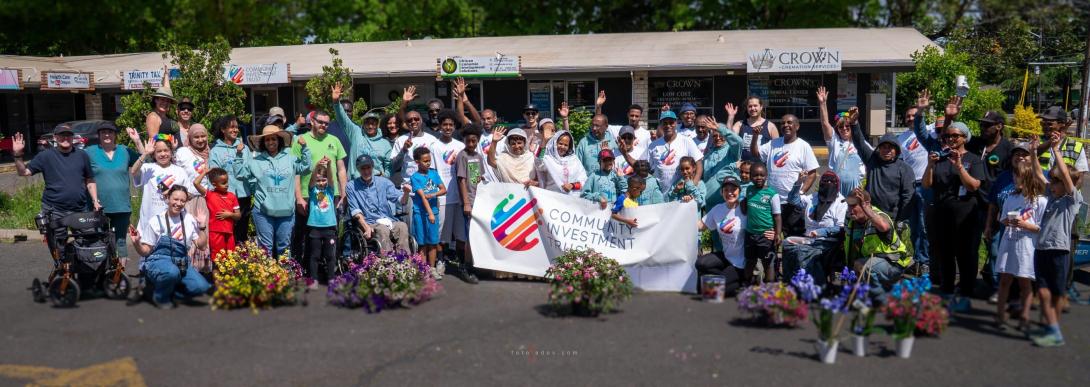
In a 2024 impact report, CIT reported that through the end of the year, 345 neighborhood resident families had invested a total of $767,000, earning 7 percent annual dividends. The initial stock value also doubled over those seven years. Overall, 51 percent of investors were renters, 59 percent were people of color, and 64 percent were low-income.
Since 2024, investments have continued; Borova says that community investment to date tops $825,000. Since CIT’s founding, investors have received more than $133,000 in dividend payments, and cashed out $428,000.
Replicating in Other Cities
In 2022, J.P. Morgan Chase awarded $1.75 million to CIT and its partners to explore the viability of the model and possible replication in eight cities. [Editor’s Note: J.P. Morgan Chase provides financial support for our work]. Borova helps support these efforts, typically guiding cohorts of partners in three or four cities at a time. “The first step,” she says “is to evaluate whether the … local organization has financial and programmatic capacity, has longevity, and knowledge and trust. The most important is community trust and engagement as well as model alignment.”
Different kinds of nonprofits are local sponsors in different communities. In Minneapolis, Cultural Wellness Center, supported by LISC (Local Initiatives Support Corporation) Twin Cities, is exploring a possible $2.4 million building purchase in the Seward neighborhood, says Anthony Taylor, who serves as a consultant in the role of Director of Equitable Development to the Cultural Wellness Center. According to Taylor, a pre-purchase agreement is in place, but fundraising is still under way before the property can be purchased and renovations can begin.
For Taylor, the project has two central goals. One is an individual wealth building component. Additionally, there is a broader community mission to “focus on BIPOC [Black, Indigenous, and other People of Color] businesses and BIPOC organizations in the community” and contribute to stabilization of the commercial corridor.
In South Dallas, the local partner is St. Philip’s School and Community Center, founded by members of an African American Episcopal congregation in South Dallas in the 1940s. The nonprofit has long operated a pre-K-6 school (that has expanded to pre-K-8) and in 2025 opened an arts center.
Julie Saqueton, director of community development at St. Philip’s, notes that the CIT effort emerged from an equitable development resident survey that expressed a desire for community ownership. Making the model work in their context, Saqueton says, has required some adjustment. “The Portland model has a large shopping center, and we really don’t have that in our area. And so, we’re kind of doing a variation on that, what we’re calling the necklace approach.” Saqueton calls the small (around 2,000 square feet) buildings that the group has acquired “pearls” in the “necklace” that the nonprofit hopes to construct.
Individual wealth building remains a key component of the CIT approach in South Dallas, but community control of land is also a major goal.
Nicole Raphiel, who works at St. Philip’s as community development project manager, emphasized the value of community ownership in preventing local business displacement. “Those properties are expected to be prime property . . . we’re . . . making certain that our local businesses have space in light of this pending change.”
Yet another replication attempt is underway in Albany, New York, where Ruth Kassel is leading an effort in South Albany, backed by a local community development financial institution (CDFI), the Community Loan Fund of the Capital Region.
Kassel sees in the CIT a way “to bring collective ownership to a neighborhood without making every [step dependent on direct resident involvement]… It lowers the first rung of the ladder” and is a lighter lift and requires less extensive trust-building work among residents than cooperatives, she says.
In Albany, the four-story building being renovated is similar in scale to the Portland shopping center. As in Portland, the Albany team is working to lease up the building, so community members can safely invest. A related challenge, Kassel observes, is “to both work with the banks, and … at the same time, make sure that this stays true and community owned.” While working with banks is common throughout community development, because a bank in this model is guaranteeing small investors against loss (the “direct pay letter of credit” noted above), the bank has to be “on board feeling good about this,” as Kassel puts it. A successful development, she adds, requires keeping both banks and community members on board “at the same time.”
Community Investment in Conventional Deals
Lyneir Richardson is exploring another way to expand opportunities for residents to build wealth—creating a lane for them to safely invest in commercial real estate through crowdfunding.
Richardson references a Brookings Institution report that found that “81 percent of the value of commercial real estate is owned by 1 percent of the population.” By contrast, the report points out, the top 1 percent of households own only 16 percent of the value of owner-occupied homes.
To counter that extraordinary concentration, Richardson founded TREND (previously called Chicago TREND) in 2016. The for-profit “social enterprise” now also owns commercial properties in Columbus, Ohio and Baltimore, Maryland, and hopes to expand to additional cities, with the most recent expansion occurring in Minneapolis, Minnesota. (Two other somewhat similar projects are LocalCode Kansas City and Partners in Equity).
TREND, according to Richardson, was started by a $200,000 grant and a $5 million, 1-percent interest “program-related investment” (effectively, a loan) from the MacArthur Foundation. Many other foundations have since joined the fund, as have the Sisters of St. Joseph and individual impact investors like Amy Brakeman.
Each purchase is structured as a limited liability partnership, with the TREND fund owning a majority share of each property. Richardson explains, “In theory we can invest as much as 95 percent of the required equity in a new purchase from the fund. And as little as 51 percent.” The remainder is purchased by community investors through a crowdfunding-type platform.
Who are the crowdfunding investors? While anyone can buy in, outreach is highly targeted. “I do these local meetings in church basements, in apartment building common areas, in the barbershop, community rooms,” says Richardson. “I bring it to people.” He adds that it is all about “extending an invitation to people who don’t [typically] get an invitation.”
To date, there are 462 community investors in TREND properties, with the average investment amount of $2,554. Of these, according to Richardson, “57 percent reside in these low- and moderate-income neighborhoods, 70 percent are Black, [and] 44 percent are women.” The minimum investment is $1,000. An Aspen Institute report indicates that the average dividend has been 5 percent and reported at the time that 60 percent of investors were of low or moderate income. Richardson says he’s aiming for a dividend rate of 6 or 7 percent after stabilization—and hopes to sell the properties after 10 years for at least twice the initial purchase cost. By 2031 or 2032, Richardson says he hopes to have over 1,000 investors and believes that TREND is on track to do that.
Can Community Ownership Scale?
Often, when it comes to building household wealth, the conversation turns to homeownership. Yet while many benefit from homeownership, this strategy has limitations. As Brookings Institution research has shown, an overconcentration of family assets in housing “poses some financial risks to households.” One potential benefit of community investment, beyond meeting community goals, is that it can enable people of modest means to diversify their assets beyond housing.
Of course, realizing this promise won’t be easy. David, who is still fundraising for her fund, cautions, “We’re going to give this our all . . . but the community has to respond, too.”
The need for field building—that is, creating a system of community supports that can sustain these kinds of community-owned real estate investment opportunities—is evident. In a society where real estate is typically very individually focused (e.g., “my home”), Haines emphasizes the importance of first familiarizing community leaders and different ethnic groups and communities with the idea of collective ownership and vetting proposed models with those groups.
Richardson emphasizes that development strategy is context dependent. “I’m making the argument that my mother used to say: everything doesn’t have to always be better or worse. It’s different,” he says. “This field advances by having multiple models.”
Add new comment