
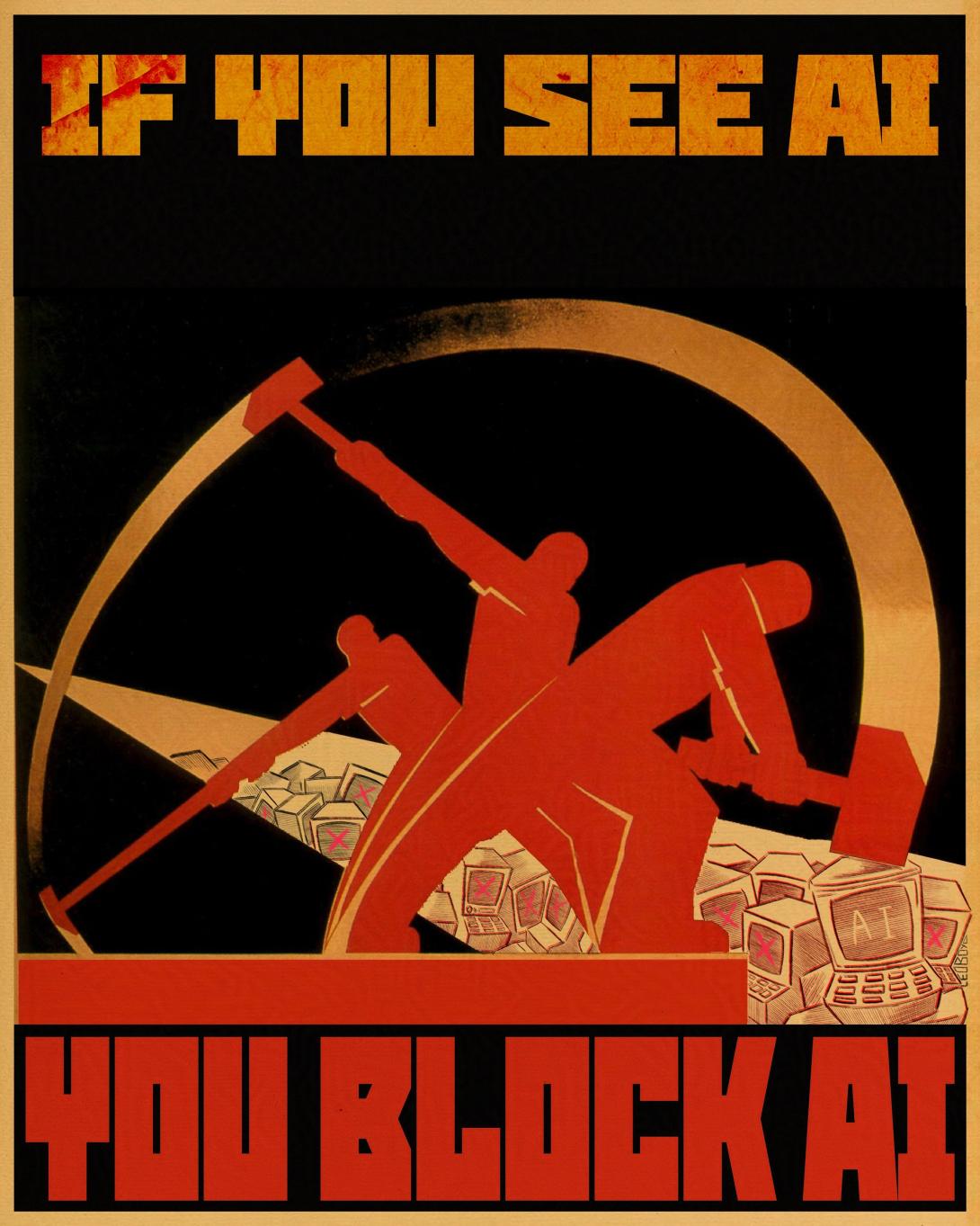
In this article I will present the strongest case that I can for why cooperatives and solidarity economy organizations should avoid the use of generative AI tools such as ChatGPT, Claude Code, and Suno. My argument is broken into four sections, starting with what I believe are the most obvious problems with these tools, and progressing to issues that are less discussed and possibly less obvious. The sections are titled Environmental Impact, Ethical Issues, Epistemological Indignities, and Business Risk; click on the title to skip to that section.
Throughout this article I will be using the terms "AI" and "GenAI" but I think it is important to note at the outset that "artificial intelligence" is a misnomer, as what we are discussing is not "intelligent" in any meaningful sense. While we humans are easily fooled into projecting our own intelligence onto these tools, something people have been doing since the 1960s, they are in fact nothing but algorithms for creating strings of statistically plausible text (or images, or music, etc). Any intelligence we see in the algorithm, came from clever programmers, not from the algorithm itself — and that "intelligence" often breaks down. When a chatbot gives a wrong answer — i.e. when it has a "hallucination" — that incorrect information is being generated through the exact same process as correct responses — it's just that sometimes the statistically plausible text happens to be true, and sometimes it doesn't. Either way, there is no intelligence to distinguish between true and false, or even to understand such a concept, just a statistical algorithm tied to a massive amount of computing hardware in a data center somewhere. Which brings us, handily enough, to the most obvious critique of these tools,
1. Environmental Impact
This headline in the European edition of Politico handily summarizes my environmental argument against using generative AI tools: "Europe must choose between AI and climate goals, data center lobby says: Tech sector says only carbon-emitting gas plants are reliable enough today to power the EU's AI goals." It is not just Europe that must choose between so-called AI and doing something about the climate chaos that our actions have already caused - it is all of us. Data centers in the US, built entirely for the sake of running "AI," are already using natural gas generators to provide for their massive power requirements, spewing pollutants into the air and poisoning the local residents in the process. In other places, they are keeping outdated coal-fired power plants in operation to provide the power their AI data centers demand. [archive]
And, of course, there is the issue of water usage. Data centers use immense amounts of water at every stage of their creation and use. First is the water needed to pour all of the concrete during the construction phase, which runs into the tens of millions of gallons per year. Then, years later when construction is finished, there is the water demand for keeping the GPUs housed in the data center cool. And that's not all. The power plants that feed the data centers also have their own water usage, and as most of the data centers being built for AI include their own power production facitility, the entirety of that water usage must also be added to their already outsized consumption.
But wait, it get's worse! Due to a number of factors, the majority of data centers are being built in areas that are already running short on water. So not only are AI data centers ramping up our already too-high carbon emissions, they are also using up our rapidly decreasing supplys of fresh water. Future generations will remember the decisions we have made, and are making, when they are dealing with the fallout. They will certainly remember those who, when faced with environmental catastrophe, instead of pulling back and trying to use less, doubled down on a resource-intensive technology because it made writing an email or coding an app somewhat more convienent.
And none of these problems, it must be said, can be solved by simply cooperatizing "AI," as some within our movement are encouraging. Even in the best case scenario, where a co-op data center were somehow built and run entirely on renewable energy, you would simply be in a situation of having added a bunch of new power generation without offsetting any existing non-renewable power at all. If we're going to do a massive build out of solar power, why would we then use all that power just to run a data center to generate statistically probable text and code, instead of replacing a gas-fired power plant? Even a cooperatively owned, renewably powered AI data center would simply exascerbate the environmental damage that we are already dealing with the consequences of, and which are already set to get worse.
2. Ethical Issues
About the time I started college, in the late 90s, there was a big media campaign to inform everyone that downloading copyrighted material from the internet was a crime. The sites that hosted this material were harassed by the authorities, some of the downloaders were prosecuted, and Aaron Swarz — a computer science prodigy and creator of RSS — was driven to take his own life while being prosecuted for downloading scientific papers for the purpose of making them publicly available. "Pirating" software or copyrighted music, movies, books, etc. was treated as a criminal offense, on par with stealing your neighbor's car, or worse. The AI companies, however, must not have gotten the message because when they needed training data for their statistically-plausible-text-generators to work with, they decided to simply scrape everything on the internet, copyrighted or not. No author or artist was remunerated for their work, and no fines were levied against the AI companies for their massive theft (which they have admitted to publicly). There are, however, hundreds of lawsuits making their way through the system against these companies, filed by the rights holders.
This alone, I would argue, should be enough of a ethical violation - and one baked deeply enough into the foundation of these tools - that cooperative and solidarity economy organizations would want to avoid use of them. But if that is not enough to dissuade use, the working conditions of the people who make these chatbots function provides further reason to reconsider any use these tools.
In order for these tools to work, human beings with actual intelligence are required to tag the (stolen) data to tell the "AI" what it is. These tasks are repetitive in the extreme and extremely low paid. So, of course, this work is outsourced to countries in the Global South, where one such worker has described the conditions as "modern slavery."
Another Scale AI subsidiary, Remotasks, pays labellers around one US cent for tasks that can take multiple hours -- wages Kanyugi likens to "modern slavery"
"People develop eyesight problems, back problems, people go into anxiety and depression because you are working 20 hours a day or 6 days a week"
Human beings are also required to keep the GenAI tools from regurgitating violent, sexually explicit or other "extreme" content - which is a real problem as the tools trained on the entirety of the internet, which is replete with that sort of thing. As a result, untold thousands of workers are forced, every day, to expose themselves to psychologically damaging material, for low pay, and with no mental health support.
“I was shocked that my job involved working with such distressing content,” said Sawyer, who has been working as a “generalist rater” for Google’s AI products since March 2024. “Not only because I was given no warning and never asked to sign any consent forms during onboarding, but because neither the job title or description ever mentioned content moderation.”
The pressure to complete dozens of these tasks every day, each within 10 minutes of time, has led Sawyer into spirals of anxiety and panic attacks, she says – without mental health support from her employer.
Theft on one end, mistreatment of labor on the other. I argue that our commitments to solidarity and cooperation should preclude our willing use of these tools - and even lead us to speak out publicly against them.
3. Epistemological Indignities
But what if we could have these GenAI tools without all the negative environmental, labor, and theft issues? What if the data centers were cooperatively owned and powered by renewable sources like wind and solar? What if the data taggers were members of a co-op? Wouldn't that mean that there were no further arguments against the use of LLMs and other AI tools? No. While there are multiple unresovable issues with these types of proposals, which some in our movement are now pushing for, even if they were reasonable possibilities they would have no effect on the epistemolgical problems that GenAI creates.
Epistemology, for the unfamiliar, is the philosophical study of the nature and limits of knowledge. The essential epistemological question is "how do I know that I know something?" Unfortunately, due to a combination of human laziness and marketing hype, many people seem to assume that the output of a chatbot is a legitimate basis for knowledge. How do you know something? Because I asked Gemini and that's what it said!
The problem with this is that, as we've already pointed out, confidently providing wrong information is a fundamental aspect of how these tools work. They will always provide a non-zero amount of wrong information, which might not be a problem if someone already knows about the thing they are asking about, so they can spot the incorrect parts. However, for the most part people do not ask chatbots about things they are familiar with, and so readily accept any output of the chatbot as factual. But given their unreliable nature, the output of a chatbot must always be verified by a human with actual intelligence, to filter the correct outputs from the incorrect ones. This necessity defeats the purpose of using the chatbot in the first place.
One could, of course, accept that Gemini or Claude is untrustworthy, and so proceed to verify that any sources they list actually exist (because they are known to invent nonexistent sources), and then read said sources to ensure the chatbot hasn't misrepresented them. After having done this due diligence, however, one has to wonder what the benefit of using the chatbot was at all, over and above an old-fashioned web search. The other option is to accept the chatbots output as accurate and proceed on that basis. This later option, in practice, is what everyone who uses these tools does to a greater or lesser degree. And understanding that the bots are unreliable is no defense for the users of the technology. Even people who absolutely know better fall into this trap regularly, and in full public view.
In a recent episode of The Stand Up, a podcast about software development, Casey was explaining some intricacies of how computers perform mathematical operations, when his co-host, Prime, interjected with "yeah, I asked ChapGPT about this and it says it varies but the ranges are usually from 3 to 80 cycles." To which Casey replied, "well it got the 'it varies' part right." This illustrates the problem perfectly. The guy who asked ChatGPT for information, and had accepted its answer until being corrected by an actual expert, is himself an expert in other areas of software development. He is a regular user of LLM chatbots designed for coding and is well aware of their failings; and yet, if Prime hadn't had Casey there to correct him, he would have continued being confidently wrong, on the basis that ChatGPT told him so.
The same problem applies to having LLMs summarize documents or emails. There is a certainty that some percentage of the LLM's output will be incorrect, but you will need to already know what is in the documents in order to spot the incorrect parts. The "AI" summary will sound just as authoritative about the correct parts of the summary as it will about the incorrect parts. And we know that GenAI tools are not particularly good at summarizing, even though that is one of the main things their backers have claimed as a use case. In October of 2025, the BBC released this report:
New research coordinated by the European Broadcasting Union (EBU) and led by the BBC has found that AI assistants – already a daily information gateway for millions of people – routinely misrepresent news content no matter which language, territory, or AI platform is tested.
[...]
Key findings:
45% of all AI answers had at least one significant issue.
31% of responses showed serious sourcing problems – missing, misleading, or incorrect attributions.
20% contained major accuracy issues, including hallucinated details and outdated information.
Gemini performed worst with significant issues in 76% of responses, more than double the other assistants, largely due to its poor sourcing performance.
Google, of course, is now trying to replace their websearch entirely with their Gemini chatbot. Anyone who thinks this is a terrible idea, is encouraged to check out https://noai.duckduckgo.com/
4. Business Risk
The most obvious business risk from using AI tools is reputational. GenAI art and writing is widely hated, ridiculed, and mocked. Any obvious use of AI tools in a public facing way will be sure to, at the very least, alienate many of your customers, and may well cause a vocal backlash. A recent example of this happened on the YouTube channel Drumeo, a channel with 5.5 million subscribers that is beloved by music aficianados and drumset players for their entertaining and educational videos. A couple day ago they managed to subvert the universal goodwill they had previously enjoyed when they posted a video who's thumbnail read "Pro Drummer vs. ChatGPT." While much of the video made fun of how often the chatbot was wrong, the comment section immediately filled with subscribers roasting them for just the act of using ChatGPT - even for the sake of mocking it. Here's a selection:
"Even though Aaron is hilarious around the ai-nonsense, please for the love of God drop this format! AI slop machine doesn't need your great platform to have additional promotion."
"Drumeo, let this be the first and last time."
"This sucks, Drumeo. Stop using AI, even if you’re clowning on it."
"Let's not insult real artists by even entertaining the use of ai generated anything, okay? Please take this video down and apologize if you want to keep the respect of thousands of musicians."
"Thumbs up for Aaron, but thumbs down for A.I. This aint it Drumeo."
"brutal to see, feel like you guys shouldve known what the response to AI would have been"
This technology is burning vast amounts of resources, stealing work from artists, making up lies constantly, and promising to create mass unemployment: is it any wonder that everybody hates it? Think long and hard before using any GenAI output in a public facing way, and understand that if you decide to use it you will be creating a lot of negative sentiment among the public. Don't say you weren't warned.
But even if you manage to keep your "AI" use strictly an internal thing, your co-op risks unintentionally deskilling its members (and workers). We have more than one study at this point that have confirmed the negative effects or relying on AI tools. To quote from a recent Nature article [archive]:
A study of physicians in Poland who specialize in endoscopy — the use of flexible probes to examine the inside of the human body — shows how quickly AI tools can erode human abilities. The physicians, who had all performed at least 2,000 colonoscopies during their careers, were given access to an AI system that analyses colonoscopy images in real time and flags a type of precancerous intestinal lesion called an adenoma. The tool was available to the specialists on some days but not on others.
Once physicians began using it, their performance dropped significantly whenever the system was unavailable. During the three-month period before the AI tool was introduced, the specialists found at least one adenoma during 28.4% of colonoscopies. During the three-month period after the tool was introduced, the adenoma detection rate for colonoscopies performed without AI assistance decreased to 22.4%.
And it's not just in medicine that use of AI tools leads to people becoming worse at their jobs. Coding is one area where the AI companies like to claim their tools are the most useful. If you hand around techy folks at all, you've no doubt heard stories of the "10X engineer" who is now ten times faster or more efficient than they were before AI. Anthropic, who own Claude Code, are at the forefront of this aspect of AI use, so when even they find that these tools are harmful, we should probably pay attention.
To investigate whether skills are being lost in the field of computer science, researchers at the AI firm Anthropic in San Francisco, California, designed a randomized controlled trial in which 52 software engineers were asked to perform a basic coding task. During the exercise, all 52 participants could search the web and access instructions on how to do the task. Half of the participants were prompted to use an AI assistant as well.
Afterwards, all of the software engineers were asked to complete a quiz about what they had learnt from the task. The participants who had used an AI assistant did significantly worse on the quiz than those who hadn’t: the average score was 50% in the AI group versus 67% in the non-AI group. The AI-assisted participants did particularly poorly on questions that required them to diagnose errors in the code, which suggests that they had failed to learn the concepts behind the code that they had just produced...
The findings are of concern, especially for students and young professionals in the field, says Crowston, who is researching how the use of generative AI tools is changing the way that software developers learn and retain coding skills. “Now you have this very odd disconnect between performance and learning,” he says. “People can perform at a pretty high level, because they’re basically borrowing skills from the AI, but they are not developing those skills themselves.”
So we have evidence that using AI tools keeps new workers from developing skills, and that it causes skill decline in experienced workers. Making regular use of these tools, or any use, seems like a bad idea if we're concerned with maintaining our ability to run our businesses, especially when the the companies making these tools are burning immense amounts of money with no path to profitability in sight. If these companies turn out to be totally unsustainable, which there is good reason to believe, and their tools suddenly disappear, those who have offloaded their cognition onto them will be in sad shape, and those who never used AI tools to begin with will be at a great advantage.
If none of the foregoing has convinced you that using GenAI tools isn't a great idea, perhaps Microsoft's disclaimers about their own AI tools will convince you.
COPILOT uses AI and can give incorrect responses.
To ensure reliability and to use it responsibly, avoid using COPILOT for:
Numerical calculations: Use native Excel formulas (e.g., SUM, AVERAGE, IF) for any task requiring accuracy or reproducibility.
[...]Tasks with legal, regulatory or compliance implications: Avoid using AI-generated outputs for financial reporting, legal documents, or other high-stakes scenarios.
An earlier version of that page went so far as to specify that COPILOT was "for entertainment purposes only" - not exactly a piece of software I'd want my co-op depending on. Even their less on-the-nose current version gives the game away. The last sentence quoted implies that having incorrect information in "low-stakes scenarios," or areas where you won't get fined for making stuff up is somehow acceptable. And a little bit of critical thought tells us that a computer system that cannot be relied on to perform basic mathematical functions accurately or reliably will certainly not do any better when it comes to anything more ambiguous than math. Which is to say, we should really read the above disclaimer as "avoid using COPILOT for...any task requiring accuracy or reproducibility."
I have a hard time imagining many tasks at any business that can be done inaccurately without any repercussion.
5. Conclusion
Each of the sections of this essay could easily include several more points, but this piece is already getting overly long. For instance, I didn't even get around to mentioning that a European court recently found Google liable for the misinformation output by its chatbot. [link] Whatever size the fine, it will not materially effect Google's balance sheet - the same can not be said for cooperatives, were one to find itself in the same position of having to answer for an LLM's "hallucinations." The list of reasons for avoiding LLMs like ChatGPT and other so-called AI tools grows every day. The question then becomes, what to do about it.
The simplest thing is just to avoid it as much as possible. Don't use ChatGPT or Gemini as a search engine, try https://noai.duckduckgo.com/ instead. Not only is a chatbot prompt far more energy intensive than a standard search, they also provide answers riddled with errors and bias, hidden behind an authoritative tone.
Many users report feeling a sense of control when using chatbots, but a February 2026 MIT study found that chatbots provided less accurate, less truthful responses to users with lower English proficiency, less formal education, or non-US origins. LLMs “may actually exacerbate existing inequities by systematically providing misinformation or refusing to answer queries to certain users,” the study’s lead author, Elinor Poole-Dayan, warned.
Where "AI" features have been integrated into software tools that you are already using, avoid using those features if possible. But also, be aware that "AI" is a marketing term, and many companies seem eager to slap "AI" on things like speech-to-text transcription that don't use LLMs and have been around a lot longer than OpenAI. I don't know if it will do any good, but emails and/or social media posts directed at software publishers encouraging them to remove the "AI" from their products probably can't hurt. And public stances against "AI" will be sure to gain goodwill in the community, even if it doesn't have any effect on Quickbooks, or whoever.
And, though it should go without saying, avoid all use of "AI" generated art like the plague. People clock it instantly, and many will either disregard it as low effort, or actively dislike it. While the simple expedient of doing the same thing you were doing in 2022 will win you brownie-points for not giving in to the tsunami of AI art slop. Some content creators are already tagging their podcasts and videos with things like "Made by a Human" and "No AI," and I would not be surprised if "100% Human-Made" becomes the new "Organic" for cultural and tech products.
Comments
Matt Noyes
July 8, 2026, 4:15 pm
Thanks for writing this. We need an overall perspective on LLMs as people active in cooperatives and other solidarity economy efforts. Of course, there is more that you would bring up if you could make this blog post longer. One thing I think of: AI psychosis, the enthrallment with chatbots that maximize user interaction by praising and otherwise manipulating them. It seems like this is related to the loss of learning and exercise of judgment that comes with reliance on LLMs.
A key figure in Japanese cooperativism, Nakanishi Goshu, said the key to cooperation was protagonism, the conversion of people into protagonists in their lives and worlds. You and I both know how hard it is, when organizing a cooperative, for people to shift from thinking in standard terms - boss, worker, employee, profit, business, growth, etc. - to terms grounded in solidarity and liberation - cooperation, commmoning, surplus, etc. That shift is a key part of developing cooperative protagonism. The further loss of protagonism due to reliance on LLMs can only make our education-organizing work harder. To put it another way, using the idea from Etienne de la Boetie, LLMs of this type create new modes of "voluntary servitude."
Steve Ediger
July 15, 2026, 11:58 pm
Josh, you've written article that I've had on my plate for over a year now. You published my points much more clearly than I could have. I'll be sharing this article widely among my contacts.
Josh Davis
July 16, 2026, 11:25 am
Thanks, Steve. I'm glad to know you find it useful.
Add new comment