
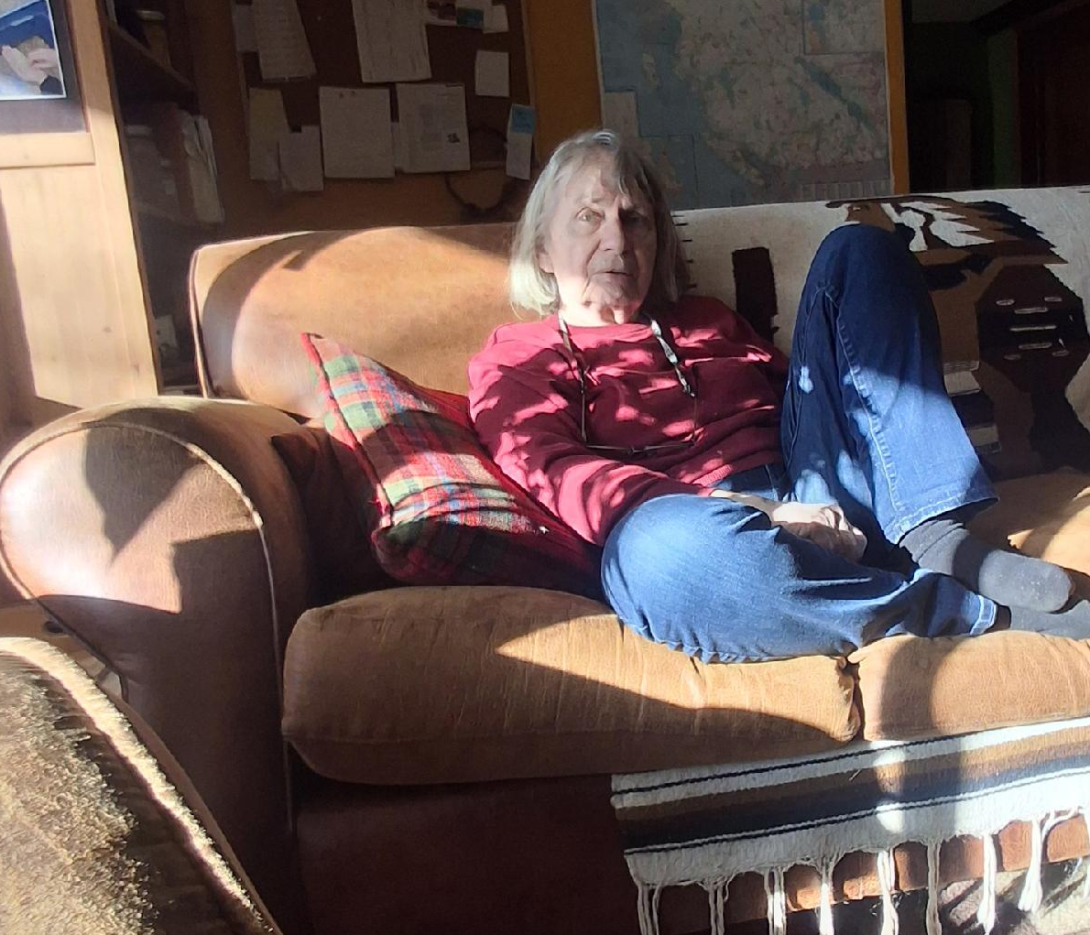
Heather Pritchard on fifty years of cooperation and commoning in British Columbia
On March 2nd, 2026, cooperative educator and “recovering farmer” Emi Do and I visited Heather Pritchard at her home on Fraser Common Cooperative Farm, near Aldergrove, British Columbia. After a brief tour of the farm, twenty acres on the foothills above the Fraser River Valley, and a conversation with fellow farm co-op member David Catzell, we sat down for lunch at Heather’s kitchen table and spoke for over an hour. The following is an edited version of her reflections.
Over the course of the conversation, Heather mentioned many cooperative organizations and key figures in the cooperative movement in British Columbia. Short descriptions and links are provided below wherever possible. Some of the key players are:
- Fraser Common Farm Cooperative, founded in 1977, a 20 acre farm in Aldergrove, British Columbia that is home to several cooperatives, including Glorious Organics and British Columbia Seed Cooperative.
- Community Alternatives Cooperative, aka the “city co-op,” a housing cooperative and urban garden in the Kitsilano neighborhood of Vancouver, a project of Community Alternatives Society.
- FarmFolk/CityFolk, a non-profit organization whose founders include members of Community Alternatives and Fraser Common Farm Cooperative to strengthen ties between farmers and city dwellers in order to build a just and sustainable food system.
- Glen Valley Organic Farm Cooperative, a 50 acre farm cooperative in Abbotsford, BC, founded in 1999 which is home to Close to Home Organics and other small farms.
- Foodlands Cooperative of British Columbia, “a provincial, non-governmental, community-based land trust incubated and stewarded by FarmFolk/CityFolk.”
Thanks to the Rocky Mountain Farmers Union for supporting this research and to George Cheney and Jennifer Dumler for feedback on an earlier draft. - Matt Noyes
I always say, “start by forming a group. If it’s just you, go back and get a group.” Find people who want to do the same thing you do, and who want to work together to make it happen. Then try it out, before you incorporate.
The origins of Fraser Common Farm go back to a study group formed by participants in the unofficial "Habitat Forum" organized alongside the United Nations Habitat Conference held in Vancouver in 1976.”1 The group’s focus was on what an ideal community would look like and how to create one. After meeting for several months, one of the participants said, “why are we still talking about it? Why aren't we doing it?”
They formed Community Alternatives Society, designed what we would call today an Eco Village, and approached the government to lease farmland. When the government changed and the land deal fell through, they raised the down payment amongst themselves and purchased 10 acres in the Fraser Valley.2 As most of the group were urbanites and not willing to give up their jobs to farm, they applied to the government co-op program and received support to build a housing co-op in Kitsilano (a neighborhood in Vancouver). They called it Community Alternatives Co-op. In the early days of the farm, people from the co-op would come to the farm to work, meet and celebrate. Money from the city folks flowed to the farm until the farm became self-sufficient.
I think there's a sweet spot somewhere between talking and doing. You don't know what it is or could be until you actually “do it.” What you're doing, forming a group that can meet together to work on another farm, is the number one suggestion I make because it's a combination of talking and doing. You can then go away, analyze it and debrief whatever.3
It is a long process to form a co-op, minimally one to two years. For me the number one priority is purpose, right? In BC, the bureaucratic, administrative stuff has been well documented and is pretty easy to follow. Whatever it is in your State that you need to do, you do.
I always say it’s good that members have a diversity of skills, backgrounds, and ages, but it’s not good to have a diversity of purposes. If a minimum of five people (legally in BC it’s three) can nail down and clearly communicate a shared purpose it’s easier for others to self-select. They will know whether or not they fit in.
Maybe you’re not sure about your purpose – you're wide open for feedback – but the more specific you can be the better. An example I often share is about a group who were starting a farm and were surprised to find a group of their friends who were involved were proposing to use the land for spa. It was awkward.
For Foodlands Cooperative, clarity around purpose is critical. We have two purposes: access to farmland in perpetuity and support to the community to manage it. This includes all the skills that are required to “steward” the land, as we usually say.4
We say “steward” because we got feedback from indigenous people in the early days, who were critical of our language. They reacted to the idea that we “manage” land. I responded, “well, what about steward?” and they said, “well, that's about as close as we can get.” Stewards are responsible to and for the land. They assure that we are in “right relationship with the land”.
So, if you've got a strong core group, maybe just go for it.
Organizing Glen Valley and Fraser Common
[One challenge facing people who want to get into farming is the high cost of land and the low income generated through farming, which is rarely enough to cover the costs of operations and mortgage payments, let alone build equity. According to Pritchard, leasing land is a common answer. "Owners often charge very little unless there is housing or infrastructure included. They receive a sizable tax advantage by leasing land for food production. It is the insecurity of tenure that is the problem. Many are reluctant to lease for longer than a few years." By separating land ownership from farm operations, placing the land under cooperative ownership and stewardship, and providing long-term leases to new farmers, the farm cooperative model makes it easier for new farmers to get started while ensuring the long-term preservation of farming land.
In a Farm Cooperative, farm land is purchased by a group of members, each of whom contribute a certain amount on money. The land is owned and stewarded by the Farm Cooperative, which leases land and infrastructure to one or more farm businesses, which may or may not be themselves cooperatives. The farmers also become members of the Farm Cooperative and as members have a voice in the policies and practices of land stewardship. Other models include use of Community Land Trusts or the non-profit based Farmland Commons promoted by The Farmers Land Trust.5 - MN]
At Glen Valley, the group was meeting on the land before they purchased it. It was owned by Gregor Robertson, and he and Amy, his wife, ended up going to Cortez, because they really wanted community and felt that out there in Glen Valley there just wasn't their kind of people.6
Gregor and Amy grew carrots for Happy Planet, a commercial juicing company, so they had a customer base to start with. But their parents owned, really, had facilitated the purchase of the land.7 So they couldn't give it away to the cooperative. And they couldn't really devalue it, but were able offer it for less than a real estate office would.
Basically, what happened was that Susan Davidson, from Fraser Common Farm, asked me, “do you think we could form a co-op and buy Glen Valley?” And I said, “let's try.” I was working for FarmFolk/CityFolk where we held the first meeting and brought together people that we thought would be interested. Right from the go, and I think this is an important point, two of them were farmers, people ready to commit to actually growing on that land.
Allison Chisholm was one of the beginning farmers. Now she has purchased land in Nova Scotia and is back to her Arcadian roots. The other was John Switzer who later went to farm on Gabriola Island. John has since passed. They were a couple and then they decoupled but continued as farmers on the land and were supported to do so by the co-op. That was the foundation.
Glen Valley organized their group based on what I always recommend: you meet together, you work together, and you eat together. Because we're in agriculture, there's always a food component when coming together. Every Sunday they held an open house on the farm and worked together. Then they'd break for potluck and those people who wanted to stay on met. It was very social.
We had an organization behind us, FarmFolk/CityFolk, who, like Young Agrarians, was set up to support the process.
Our farm, Fraser Common Farm, totally supported the process. Velma Barbolet, one of our members, approached her women's circle and all the women that she knew to become members. Most of them were professional women in their mid plus years and could afford to purchase a $5,000 share.8 Some had grandparents who had lived on a farm or always dreamed of owning a farm. They bought shares for their grandchildren. Velma was a real promoter who got many people to sign up. They formed a board made up of non-resident and farm resident members.
Fraser Common, on the other hand, doesn’t have a “board.” From the beginning we were governed by a group we call Farmkeepers. Farmkeepers is a group that meets regularly to manage the business of the co-op. They're mostly residents, but we do have a few non-residents who connect via Zoom.
We have more people living on the farm than they do at Glen Valley. I'm going to say – but this is just me – we were considered anarchistic. We took risks with the government regulations, figuring, as long as there was consensus amongst us, it was better to ask for forgiveness than permission.
Glorious Organics is a worker co-op that runs an agriculture business on Fraser Commons. Their relationship is defined by a five-year renewable working agreement, aka lease, that is reviewed every year. Glen Valley is not dissimilar. Like Fraser Commons they own the land and lease it to different businesses on the farm.
All of the businesses are also members of the land co-op. That is key. We didn’t set it up as “us and them.” Instead, we ask how is this going to work for everybody? Not that Glorious Organics doesn't have a lot better idea of what they need than the rest of us, but, as members of the land co-op, they have a voice in overall running of the farm and are not going to do anything, as Glorious Organics, if it's going to harm the rest of the farm. This is the model that we took to Glen Valley. I don’t remember how we came by it, I think we made it up. It evolved and is still evolving.
In the early days (1985) Herb Barbolet, who started the salad business (Glorious Organics and Seasonal Salad Co) with me, was insistent on autonomy for the business. He absolutely did not want people in the co-op who loved the “idea” of setting up a business on the farm – but weren’t available to meet very often and didn’t see themselves working in it – to have a say about what to grow and who to sell it to. It seems common sense to me now, but at the time people who loved the idea wanted to be involved in deciding what it would be.
Somebody said to me just recently, I can’t remember who, but I say it all the time: “Don't give me your ideas, I've got lots of my own. I can't follow through on all the ideas I have. If you have a good idea, make it happen. I'll support you.”
Getting along
Doesn't it come down to leadership then? Don’t we have a kind of crisis of not understanding leadership? Not taking responsibility that needs to be taken in order to make something happen, waiting for somebody else to do it?
I lived in the City co-op (Community Alternatives) before we had this second property (part of Fraser Common, where Pritchard lives), and I actually commuted from the City co-op to start Glorious Garnish and Seasonal Salad Company (the precursor to Glorious Organics).
I did that for a couple of years, and then the opportunity came to purchase the second piece of land, the second 10 acres, which is where we are today. Velma, who lived on the farm, and myself decided we wanted to do this. “This is something we're going to do.” Huge amount of work – would we have done it if we knew how much work it was?
For me, the challenge was we were going by the old way of consensus with people feeling they had the power to block.
Figuring out how you're going to govern yourself is critical. I love Sociocracy, because it really defines a smaller group with a clear aim, and agreement to do the work, and the group has autonomy to do the work. It asks, “Is it good enough for now? Can we try it?” “Yeah.” “Oh, the two of you really want to try it. Okay, I'm a little skeptical and can't get involved but why don't you try it and come back to us in a month and see how it's going.” That language and the culture of it, changes from “am I for or against?” Which, for me, is huge.
My grandson Gerhard recently gave me the lecture on non-binary thinking. Left or right, right or wrong, this or that, whatever it is, you know? That’s a tool capitalists use to divide us. – This is a 19-year-old telling his grandmother! – If we already know something, we can't be informed by science. We don't use our creativity, we just take a position and fight our position against each other and in the meantime, of course who's gaining? You know, the economics of who has control.
So since then, I've seen things like a lot more like “and plus.” It's not “either or” It’s very seldom that you have to make those either/or hard choices. Maybe sometimes you do, but usually you can negotiate something that will work for everyone. If people don't want to negotiate, then you're in trouble. They put themselves outside the process.
One of the things that is sometimes difficult in co-ops, is when people chase after potential members because they have money. The co-op needs money for development, and here's this person with money who seems to want to leave a legacy. It seems ideal, but often, as was one case I was brought in to facilitate, the money comes with strings attached, because they often have an idea about how it's going to benefit them. When they see that it's not going the way they thought it would, when they've got them dependent upon it. In this case, I remember the two people involved were calling each other mentally ill. And I kind of thought they were both right [laughs].
Amir Niroumand from Abundance Farm9 said the requirement for membership should be “to be in therapy.” I said, “Amir, you can't make that a requirement. People aren't going to do that...” And he said, “well, but they need to know themselves and how they're triggered and be responsible for their actions and the words and their participation.” It's a high level of self-knowledge.
You have to build it into the culture for one thing, but you start by working together, doing the work you want to be doing. You see how people show up.
So, I think be wary of situations where people are wanting to purchase property from owners that do not share their values. And the owners who see it as, “well, I can get a community group to buy my land, right? And they can go and get grants...”
In two cases I know of, the land was overvalued because the group that wanted to buy was fixated on a particular piece of land. So that would be my number two: don't get fixated on the land itself. Don't do everything that you can to get that one piece of land when you've got a landowner like this. One landowner, and I met him with more than once, said things like... “Well, you know, I've got a developer who's going to offer me a lot more than that.” And I said, “tell us what it is that you need and that's what we will pay,” and we fixed the price. Because we are not going to jockey with developers.
In the end, that property, that was the five-acre farm on Nanaimo, was bought out by the municipality.10 And now it's a community asset and there was a big fight for it not to be turned into housing, and stuff like that. So it's, it's kinda neat the way it's gone. There's mixed activity on it. There's limited housing, but this is continuing as an area for growing food.
Horse Lake Farm Cooperative is another example.11 I know that they are still looking for people to farm, because there's a lot of opportunity there. Their co-op model is based on Glen Valley. They were able to form a cooperative to purchase the land, but one of founders passed away and the others are elderly. They really need succession. So I guess a big thing that you probably talk a lot about is succession. How do we, as founders, stay open and flexible enough to bring new people in so we don't lose the purpose or the values, but we also recognize young people coming have their own dreams. They're not my slaves.
Let me tell you, we've had farmers like that. They “know how to do it,” and they've been doing it for 30 years, and this is the way you do it. And they just want to teach people how to do it right. Avoid that.
Living Cooperatively
[Housing is a challenge for farm cooperatives. Many small farms are zoned for a single-family residence, and it's certainly helpful if there is an existing home on the property. But cooperatives involve groups, as Pritchard says. And, the rental income that members generate can provide essential support to both the farm cooperative and the farmers operating on it. In some cases, a cluster of small/tiny homes may be possible, as is being considered in other farm co-ops and commons. - MN]
I'm now living here on my own. During COVID, my partner Michael came and joined me. Michael and I have been together since 1979, so coming on almost 50 years. We never got married, but we have cohabited sometimes in the same place, sometimes not. And now with COVID, we became a domestic bubble. And it's great, for me anyway, it's really, really great. But people change their mind about communal living. They might come up and think, “oh, yeah, this is a great idea!” And then they try it, and it's just, like hard. And some people are saying, “we can work together cooperatively, but to extend that to living together, too, as well…”
People always ask me, “where does everybody live?” And it takes me a couple of minutes to ground myself and say, “well one member has her little cabin there where she sleeps. She socializes and eats in the big red house. Another member lives on his own in a small house gifted to us by a friend.
When you come up the driveway, to the white house, there is a suite upstairs where two other members and their three kids lived together until they separated. The father moved into the red house where he has space for the youngest child. The mother remarried and her husband moved in with her. He is now an active member of the co-op. The father has a new partner who lives in the city but comes out frequently. She too is a member who has parked her trailer at the back of the house so, when she visits, they have a private place to go.
And then there's my partner and I. He lived in the city co-op with me until there was an opening at the farm. I stayed in the city, so he and I were back and forth a lot. In 2000 when we bought the new property, I moved from the city co-op to the farm. Now he retains a space in the red house as his office but shares a space with me in the basement of the white house.
Two other people are building a beautiful tiny house; they will move into when it’s finished. Another one now has her own tiny house, built by another member, who also lives in a renovated space. People have moved from being close to being separated, coming back and being re-coupled. Every possibility you can imagine.
In the early days we were written up as an intentional community. There was resistance to that in the group, being labeled “intentional communities.” Not everybody objected, but there was a division. Partly it was because some people thought of intentional communities as being a bit on the flaky side. Also, many international communities were faith based and we were more social/political.
We saw ourselves as a rural-urban community with a rural co-op (Fraser Common Farm Co-op) in Aldergrove, and a city cooperative (Community Alternatives Co-op) in Kitsilano. And everybody who was a member of the city co-op became a farm member as well. There was a split at a certain time when somebody in our group felt this was illegal and was going to rat on us, you know, like “you can't have a registered CMHC (Canada Mortgage and Housing Corporation) housing co-op and demand that people buy shares in the farm.”
We stopped saying you have to be a farm member too, but we felt that because we made our decisions by consensus, that we had all agreed to this, it was okay. This is what I mean by a little bit of disrespect for authority, or anarchy.
But that was the start of the separation. The city people were incredibly supportive of the farm. They gave their personal money.
CMHC set the housing charges were based on income. For example, according to my income I only needed to pay three hundred and fifty dollars, but I pledged $600. And I think Herb was the first one that raised that idea of pledging. He said, “look, I'm a student, but I have means. As a student I only have to pay $50, but that's not fair.” The difference between paying what CMHC determines and what we are willing to pledge is what funded the work of CAS (Community Alternatives Society).
CAS was registered separately from the Community Alternatives Co-op and it was an overall society that served both the farm and the city and connected the two. So like that's where the intentional community comes in. People like myself, Kaz, (who has since passed away, most of the early members have now passed) and Susan too, and Michael, we all gave way more money than the CMHC regulations require. That's what funded the society.
From Financial Ties to Relational Ties
Over time, the farm became very self-reliant. We no longer needed support from the city. So, because money wasn't coming in, the ties are now relational rather than financial.
Michael, who lived in the city co-op for 15 years, often stays overnight there when fixing the rotary composter he built back in the early 80’s. My two grandsons now live in the city co-op in the same unit their mother and I lived in. Sometimes I am asked to help with conflict resolution. Because I have a long history, I understand the group. It's all really relational. And some people come out to the farm.
Some of the relational stuff is formalized, like BC EcoSeed. Did you get a tour of that? Well, I love it, you know, I loved it because when I was working for FarmFolk/CityFolk, I partnered up with Patrick Steiner, a seed grower, and I thought that it was really important that we organize seed growing in BC. And so we formed BC Seeds under FarmFolk/CityFolk.12
I say that and go back that far because it's the relationships we built under that, connecting with seed growers across BC and asking what could we do to support each other?
Fast forward: there was a philanthropic donation given to USC Canada at the time (they call themselves Seed Change now).13 When they were given a huge, huge donation for seed security in Canada, I went to Ottawa, to help design a Canadian seed program. In the process of regionalization, FarmFolk/CityFolk was contracted to run the seed program in BC. I worried that, when the 3 year funding period ended, we would run out of money. I asked “well, what do we do to keep this going?”
The answer: form a co-op. Assisted by FarmFolk/CityFolk, seed growers had already formed BC Seed so they were linked and co-operating. BC EcoSeed Co-op started with eight growers at the time of incorporation and have grown to 25. We had the same questions anyone would have in forming the co-op. The big fight was whether we should be organic or not.
This is where either/or doesn't fit. Transparency fits. You tell people about your seeds and if they’re not organic they don't get labeled organic. If you've got a story, you tell the story. If you’ve got customers, you keep your customer base. The co-op doesn't take over and say, “you can only sell through us.” That's what Patrick was worried about. I said, “well why would you want to do that? This is your co-op, Patrick. You decide what you want to do. You want to all keep your own businesses going. You keep the businesses going, you keep your logos and seed packages, and form the co-op around what you need it to be.”
And the co-op does other things. The purpose of it is to bring the community together to test each other's seeds, to learn from each other. Because they are isolated, they want feedback. The other thing of course is they don't have to be only a seed grower. They can be a farmer that grows one kind of seed. Yeah, and I'm so thrilled. Not only am I thrilled that it's successful. But I'm thrilled that we were able to give them a forever home here on Fraser Common where they have a thriving online business. Other places that offered land were individuals whose situations, though supportive for a time, were subject to change. And you know, you can't really build the foundation you need to build on a farm unless you know it's not going to be sold.
What is interesting to me is working with groups at different stages. You know, we at Fraser Common have so much in common with Linnaea Farm because Linnaea was formed at about the same time we were.14 And it's kind of fun getting together with the founders.
The other thing I guess is that we're setting up all of these Zooms and meetings and phone calls with more than me. It's like there has to be two of us before we set up a meeting. And we have to get two of them from the farm because we want different perspectives.
Succession
I'm currently in a succession process. I'm wanting to pass this on. To do that other people have to join me. Yeah. And it's great because as soon as they start to get connected, not that I need to back off or necessarily want to, they develop their own relationships.
I mean Michael has developed relationships with all these folks because he's been with me and we often traveled together. Amir Niroumand from Abundance and Ben from Lifeboat, now know these farms.15 Ben is really excited about going to Linnaea. Amir has already made a really strong contact with Linnaea. And I know Daria Zovi from The Quarry Farm on Salt Spring is in, I just know this, she's in exactly the same situation there.16
Questions of equity are high on the list for most of our co-ops now, the ones that have formed or are just forming. How do we get equity? Think of somebody like Tamara McPhail from Linnaea, who has spent 25 years on the farm. And all of us who, this is all non-monetized: it is not a financial relationship. And what do you do after that time? What do you walk away with? You've put your money, resources and your energy and creativity into this social experiment for 25, 40 years. I'm really interested in it and so is everybody else.
How can we be creative about that to assure that people who are now at my age are not just put out to pasture?
We've created something I would really like to reverse in terms of our culture. We've created a poverty mentality. You're asking me what should we look out for? Make sure that we honor the fact that people have a long life and they need finances in order to get along in a healthy way. Somehow those things have to be taken care of. Housing can be taken care of. It is probably the easiest thing to be taken care of on land because you can build it and we can finance it in a way people either can pay very little like we do, or at a certain age they're granted housing for free or whatever it is. But other things, like when you're bringing up kids and all that kind of stuff. I mean, where does the money come from? How are you paid to look after the expenses that are not taken care of by the co-op?
Like all farmers, everybody's got their own jobs on the side. I mean, my grandfather did that a hundred years ago.
On our farm, Mark is making a really good living now on the farm. But when you think about it, partly it has to do with the fact that he has land that he leases at a very low rate. He has housing, like at $500 a month for the whole house including utilities. But then you have to be smart enough, not just to say to yourself, “oh well, I can get by.” So, it's like we create situations where people, and it's really a good thing, they need less and less money. But then having less money means also they can't leave.
I mean if they want to leave, they have no resources to leave. They can't pay the going rate on the outside, right? Or they haven't saved enough to do that. So that is an issue that's top of my mind now.
I can say it's the success of the co-ops that's creating this problem, because people aren't leaving. If you come in and you're in your prime of life like you are, and you have two or three years in it, and then you learn some things, and you leave, and then, you get a government job or something else, you can make enough money. But if you are actually going to stay for 25 years, then what happens after that?
I've been really involved with Lifeboat Academy on Pender Island, and they're very sophisticated. They're addressing it right from the beginning. It's also because they need to raise a whole lot of money. They have to go to people who have money and are okay with their investment giving them a social rather than a financial return. Still the money they put in is seen as their money, money they've investing not donating. There's a difference between donating it and getting a tax receipt and investing it. A social investment in form the shares can be sold to other people. Over the years people on the land: in the “farmastery” as they call it will have, for 25 hours of work a week, their house and food expenses covered. Beyond that their time will be logged and valued and they will get a share of money raised whether that be from the sale of product or services. For them as a community farm, offering workshops and other product and services creates a multiple streaming system. They recognize right at the beginning that they couldn't make a go of it, just farming, but the farming is the basis of that.
They are forming a multi-stakeholder Co-op and very close to incorporation. There will be three types of shares: community shares for community support, shares for the people who actually live and work there, and then the people who are investing in larger amounts. It's been very interesting and complicated to make sure that investment capital is protected, but they don’t have a say over the program and daily operations.
We are not taught to co-operate; we are taught to compete. We're taught that there are winners and losers: your value is based how much control and power and influence you have, and not how well you get along.
We talk a lot about this. The core group of Foodlands are meeting to address what systemic change we would like to see. Vancouver Foundation has a program that grants money to organizations that are addressing systemic change.
I think one of our systemic problems is our relationship to land. I would like to change our relationship with land in the most radical way: that we don't own it. We are stewards here for a certain length of time, we have responsibility to be in right relationship to the land, to see it not as a commodity but as a sacred trust. We need to challenge our belief that land ownership will provide us with wealth and security and is the best way to invest in their future and our retirement.
There’s an idea, “If you don't own land, you're somehow a failure.” That’s the fundamental change we need to make. Along with this is our relationship with each other. How do we be in right relationship with the land and how do we be in relationship with other? The last little bit of money we have in Foodlands, is funding a project we call Aging in Place.17 And it's expanded beyond aging in place, it’s gone to how do we care for each other? Because I am in my 80s, it does not mean I will necessarily need care more than somebody else who has a sudden accident or cancer or whatever even if statistically the four elders on our farm, who are over 70, are the most likely to need care.
And I'm thinking that the only way people are going to express generosity when it comes to people who need care is if they've experienced it. In families where the elders are being taken care of and it's part of the family experience and there's something enriching about knowing your grandparents and stuff that's going to pass on. You know, my sister and all of us took care of my mother. My daughter is going to take care of me. Care doesn't have to be institutionalized, but it needs to be experienced and valued. And, yeah, and we don't have much of that in our culture.
We don't have much community, right? Beyond the biological connections we have, do we have communities that care? And communities that do, we all know that, I mean, the blue zone all over the world is like... You know, here are people who live till over a hundred because they're active and they have purpose and they eat well and they walk around and they're in community and they dance and play music, enjoy each other. A lot of those things which don't have to be monitored either.
Changing Traditions
If you were here in May, you would have been able to celebrate with us the end of spring and beginning of summer. May Day on our farm is a long-standing tradition.
It's colorful, it's festive: based on Beltaine, a Celtic tradition. Last year we changed it up. The person who was guiding it for years was wanting to retire and we were getting feedback from the next generation that it was so gender-based. They started to feel this was “creepy”, you know? Somebody made the comment when they carried in the maypole that only males can carry the pole and males/lads go one way and females/gals go the other.
It's not even symbolism. It's the songs and the bawdiness and the joking and everything that goes along with it. I'm of an age that thinks “that's tradition” and I just accept it. Well, young people or some of them who are gay and trans and everything else, are vocal about this not being an inclusive event. We addressed the issue, which brought up many lively discussions. We now focus on the fertility of the land rather than the fertility of the penis being jammed in Mother Earth.
Well, what if you don't identify with either? Then you take the ribbons, and the red ribbons go one way, green go the other. It's so simple. The format for the revised May Day was really, really successful.
That's exactly what we're talking about: changing the culture. But it was fundamentally this thing, when you think about everything being binary: if you win somebody has to lose. Yeah, that's getting down to the basics.
No matter what people say it's as my brother-in-law says, “don't listen to what he says, watch what he does.” And I sometimes think about that. That's why if you're doing a cooperative farm, you've got to be growing food. Growing it, taking care of it, taking care the soil, even if it's a small thing. It doesn't have to take your whole life.
I remember going to Gabriela Island to address a group about putting land in trust. There was a group of people trying to purchase land and put it into trust and another that were looking at growing on the land together. They felt under pressure to form a co-op, but when I talked more about “co-operation” than being a co-op they said they were “so relieved they weren’t obliged to incorporate. Like you don't have to get married.
Forming a co-op is, if it serves you, if it serves you to be registered, then do it, but I mean, it has to be based on you co-operating with each other. I have to figure out how to say that right from the beginning because it seems so common sense to me, but like you were saying, people are focused on incorporating rather than what do we want to do together? How do we do that together? Who's going to commit to what? Keeping our word and honoring our commitments, meeting regularly being willing to take the time to make it work, then we get to a place where we say, “hey, okay we'd like to go for some funding we want it to be recognized or whatever it is you know, let's incorporate.” I think the advantage is that you become part of a larger community too, which I think has that.
Last thoughts
How do we be together and take care of each other? If we're together as a cooperative, we care about each other, we get to know each other and make adjustments and accommodations. I think a lot of work I do is changing from a competitive to the cooperative mindset.
[Corrections made on July 4th, 2026: clarification of Pritchard's role in founding of Fraser Common and FarmFolk/CityFolk; United Nations Habitat Forum as unofficial gathering; advantages of long-term leasing, name of BC Seed. - MN]
- 1
“Habitat I” – a United Nations Conference on Human Settlements, held in Vancouver, British Columbia, from 31 May-11 June 1976. https://www.un.org/en/conferences/habitat/vancouver1976
- 2
A rich agricultural area in British Columbia, a few hours drive East from Vancouver.
- 3
Pritchard is referring to the Sun Mountain Farm Club, an experiment in cooperative farm work in Colorado, which we had briefly discussed. After two years of work and experimentation, we are now forming a worker cooperative that will connect local farmers, farm workers, and community supporters.
- 4
“The Foodlands Cooperative of BC is a member-powered provincial cooperative that facilitates the capacity building of community groups to make land accessible and secure for food provisioning. The Foodlands Cooperative upholds and advances the public interest for sustainable land use and provides tools for the protection and stewardship of food providing lands across BC.” https://www.foodlands.org/
- 5
See the excellent materials on the Rocky Mountain Farmers Union website: Expanding Land Access https://rmfu.org/ela/
- 6
Gregor Robertson went on to serve as mayor of Vancouver (2008-2018), and has served as Minister of Housing for the Federal Government since 2025.
- 7
In Abbotsford, British Columbia, site of Glen Valley Organic Farm cooperative.
- 8
Chris Bodnar, a farmer-member of Glen Valley, explains the investment process and his own ideas about cooperation in this very useful episode of the Market Farm podcast https://collaborativefarming.libsyn.com/website/a-simple-cooperative-farm-model-a-short-history-of-modern-co-ops-w-chris-bodnar-of-close-to-home-organics.
- 9
Abundance Community Farm, founded in 2016, in Agassiz, BC. https://www.abundancecommunity.farm/
- 10
Growing Opportunities Farm Community Cooperative is a non-profit farming co-operative established in 2013 in Nanaimo, BC. https://www.growingopportunities.org/
- 11
“The Horse Lake Community Farm Co-operative is within the Tsq̓éscen̓ First Nation's (Canim Lake Band) Traditional territory of the Northern Secwepemc te Qelmucw. The farm is located near the town of 100 Mile House, in the South Cariboo region of... British Columbia.” https://www.horselakefarmcoop.ca/get-to-know.html
- 12
BC Seed Suppliers. https://farmfolkcityfolk.ca/find-seeds/bc-seed-suppliers/
- 13
Founded in 1945, Unitarian Services Committee became Seed Change in 2020. https://weseedchange.org/
- 14
Linnaea Farm “feeds and educates the Cortes Island community and opens up the farm for organizations such as The University of Victoria Permaculture and Power of Hope.” https://www.linnaeafarm.org/
- 15
Lifeboat Academy is “a working farm as well as an experiential education and retreat centre...building a model mixed-used regenerative farm with an integrated blend of pastures, food forests and gardens growing a variety of healthy food while increasing the vitality of the environment.” http://www.lifeboat.academy/
- 16
The Quarry Farm. Salt Spring Island, British Columbia. https://thequarryfarm.ca/
- 17
For details, see: https://search.open.canada.ca/grants/record/esdc-edsc%2C014-2024-2025-Q4-03417%2Ccurrent
Citations
Heather Pritchard, Matt Noyes (2026). “Start by forming a group.”: Heather Pritchard on fifty years of cooperation and commoning in British Columbia. Grassroots Economic Organizing (GEO). https://www.geo.coop/articles/start-forming-group
Comments
Eduardo Mercovich
July 8, 2026, 3:56 pm
Dear Matt and Heather, thank you for so much lived experience distilled on this talk... it reads as if we were on that living, with the sun going in after a day of work.
I cannot express how important is all this informaton for those of us that are trying other -more humane- ways of living together. In our case, on Confluencia, in Buenos Aires, Argentina.
I will continue to check here on GEO for more treasures like this one.
Again, thank you both very much.
In solidarity...
--
e
Matt Noyes
July 8, 2026, 4:24 pm
Thanks, Eduardo! I want to know more about your experience with Confluencia (https://confluencia.coop.ar/). Do you have articles to share?
Bruce J Reynolds
July 9, 2026, 8:19 am
Appreciate the point made that a group can work on their co-operation abilities before rushing ahead to incorporate as a co-op.
Add new comment